Sinhalese New Year
Food, Games and Traditions
 Sinhalese New Year Symbols
Have you ever celebrated a new year in April? For Sri Lankan families around the world, that's exactly what they do!
The Sinhalese and Tamil New Year, known as "අලුත් අවුරුද්ද" (Aluth Avurudu or Aluth Avurudda), is one of the most joyful and colourful festivals of the year, filled with traditional food, exciting games, and the warmth of community.
This year, one of our young readers, Saviru Bandara, who lives in Sydney with his family, brought all of that magic to life a little early, and we are very lucky to learn about this important festival and be right in the middle of it all!
Here are the insights Saviru Bandara shared with us:
Celebrating Sinhalese and Tamil New Year
Different cultures celebrate new year in different ways around the world.
The Sinhalese and Tamil new year is celebrated by Sri Lankans and usually falls on 13th and 14th April in each year.
The new year is celebrated according to the movement of the sun, marking the transition of the sun from Pisces to Aries. While the start of a new solar year is called "Aluth Avurudda" (අලුත් අවුරුද්ද) in Sinhala, the Tamils call this New Year celebration "Puthandu".
[Aluth Avurudda as well as Puthandu mean "New Year" in English].
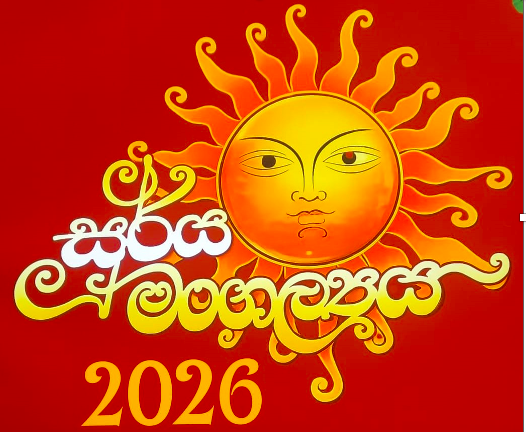 Poster at the Sunfest in Sydney
This year, I have celebrated the Sinhalese and Tamil New Year festival called "Sunfest" or "සූර්ය මංගල්යය" in advance in March at our community language school in Sydney.
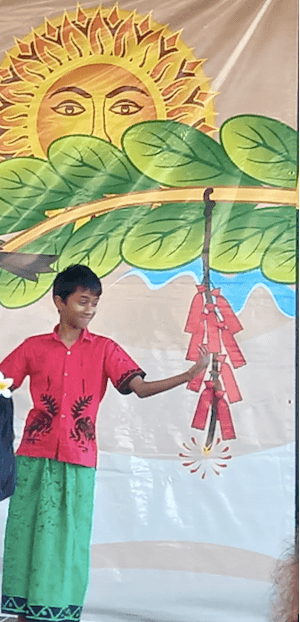 I am wearing the Sri Lankan traditional costume: sarong and shirt
It was a joyful event that brought families together and helped us share our culture, traditions and happiness.
On the day, just before we went to the community language school, we put on our traditional clothing called "sarong" for pants and "kamisaya" for shirts.
When we arrived, we watched the cultural show in the morning, conducted by our Sinhala school.
We did a group dance at the stage with a song "Me Aurudu kale" (මේ අවුරුදු කාලේ) created by Sahan Ranwala uncle, a famous Sri-Lankan artist in my mother country, Sri Lanka.
After the cultural show, there was an array of delectable sweets and cultural foods, such as aasmi, kawum, kiribath with lunu miris, (a spicy spread), kokis and more!
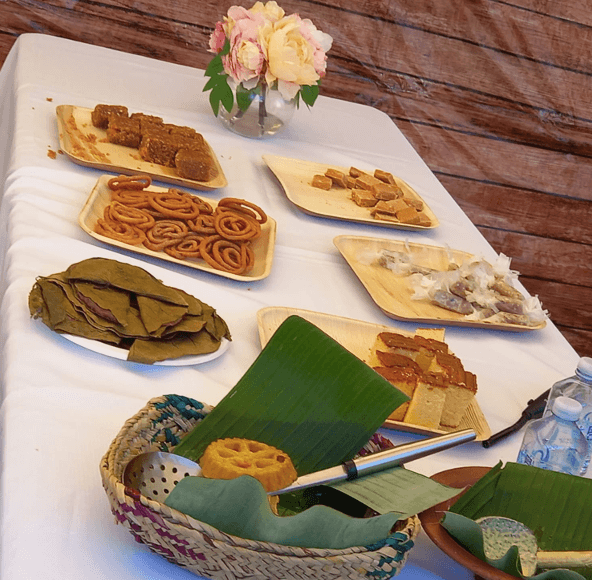 Festive table with Awurudu sweets
Sinhalese New Year
Sinhalese Awurudu Sweat Meals
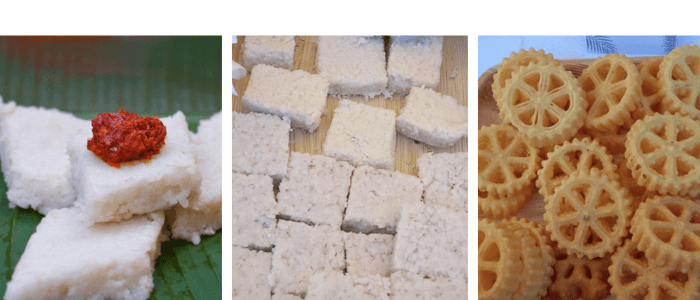 Kiribath (කිරිබත්) with Lunumiris (ලුණු මිරිස් ) and plain - Kokis (කොකිස්)
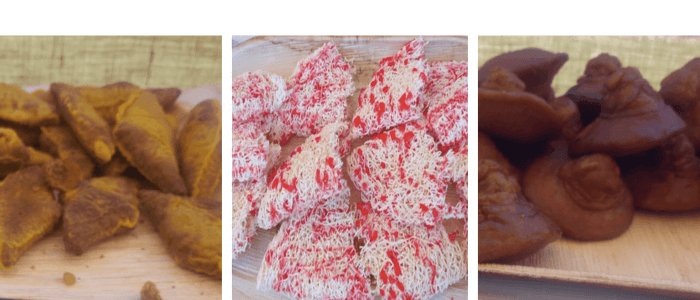 Mung Kavum (මුං කැවුම්) - Asmii (ආස්මී) - Konda kevum (කොණ්ඩ කැවුම්)
Sinhalese New Year Celebrations
Awurudu Games
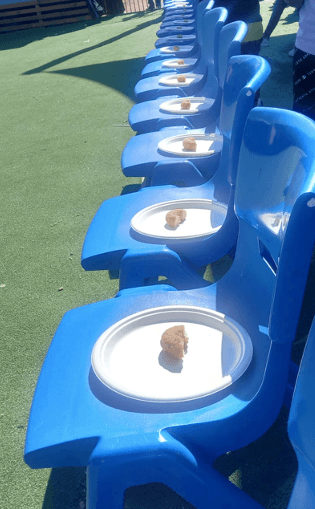 Donut race
Next was the Sinhala traditional Awurudu games. The game we first participated in was the "donut eating".
First, they tied up our hands behind our backs at the starting line, and then we ran to the plates on the chairs. We ate the cinnamon donuts with our hands behind our backs.
And because they couldn’t find the Sri Lankan traditional Sini Banis (සීනි බනිස්) in Sydney, so instead they used cinnamon donuts as an alternative.
Sack race (ගෝනි රේස්)
The sack race was a very fun and engaging activity where we jumped in the sacks waist deep and jumped across the field until we reached the end. It was a very competitive sport.
Usually, I am good at a few games, but I could tell it was very competitive as I couldn’t go in the top 3, which was disappointing, but still very fun as I still got to participate in the sport.
Balloon bursting (බැලුම් පිපිරවීම)
Now for me personally, the balloon bursting was a tricky activity, as blowing the balloon was not the fear, but the pain is what I fear. Imagine popping the balloon and feeling the searing pain spreading across your lips. Anyways, if you’d want to know the rules, the rules are simple like I said. Just breathe into and pop a balloon, then run to the finish line.
Lime and spoon
The lime and spoon race is really fun. It is like the egg and spoon race, but instead you use a lime.
For this race, we hold the spoon with only one hand instead of both hands to make it more competitive. However, it is a bit easier too, as the lime is slightly smaller than an egg, which gives you a higher advantage of winning the game.
If you fell down, you had to restart the game, or if you didn't want to play, you could simply drop the lime and spoon.
Kana Mutti (කනා මුට්ටි)
Kana Mutti has got to be my most favourite game as it consists of candy in the game. You must get a stick or a bat and be blindfolded and stand still.
They spun us around three times to confuse us, so they won’t make it easy. The spectators and judges were allowed to tell you where to move so this made it easier.
Once the clay pot is broken, candy drops down, and you can rush to get them. I usually end up with barely any candy, but I just shrug it off.
Aliya Gata aha thabimma (අලියට ඇස තැබීම) "Keeping an eye on the elephant"
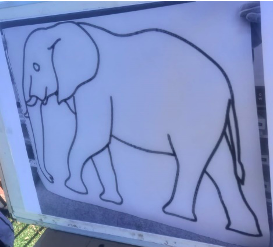
In the Aliya Gata aha thabimma game, the judges or volunteers drew an elephant on a whiteboard or sometimes on a blackboard. This game is recommended for kids and students for its simple steps on how to play.
Tie a headband on their eyes to make sure they don’t see and give them a marker. They then must get the marker and put a dot on the elephant.
If no one gets it, the closest person to the eye, will win the prize.
Tug of War (කඹ ඇදීම)
I’m sure you guys know how to play tug of war. But just in case you don’t, I got you covered.
There are two teams and a coloured cloth in the middle of the rope. Whoever’s team pulls the cloth the closest or makes all the other team fall.
Musical Chairs (සංගීත පුටු තරඟය)
Again, this might be another game you'll know. [Edited: Everyone walks in a circle around a row of chairs while music plays. When the music stops, everyone rushes to sit down, but there's always one fewer chair than there are players, so someone will be left standing and is out. Each round, another chair is removed, and the last person still finding a seat wins.]
At the end, even If you win in everything or lose in everything, everyone participating who didn’t win still without a doubt gets a present. So don’t worry if you are bad at sport or activities, because you will always get a gift.

What makes this blog post so special is that it was written by 11-year-old Saviru Bandara, a Year 6 pupil from Sydney/ Australia, who also attends a Sinhalese community language school on weekends. Images were provided for above text by Sujatha Mayadunnage.
It is wonderful to read from someone who is keeping their culture alive far from home. Through his eyes, we get a unique and passionate glimpse into an important Sri Lankan tradition.
Whether you are Sri Lankan or not, reading about Avurudu is a strong reminder of how powerful cultural festivals in bringing people together!
We hope this inspires you to learn more about the Sinhalese and Tamil New Year. Now let's share the most important facts about the Sinhalese and Tamil New Year Celebrations:
The Sinhalese and Tamil New Year Celebrations
What is Aluth Avurudu?
Avurudu is name of the Sinhala or Tamil New Year celebrations in Sri Lanka. Avurudu is celebrated every year on 13 or 14 April. In Sri Lanka, the Sinhalese (Buddhist) and Tamil (Hindu) communities celebrate the new year together.
Unlike most new year celebrations around the world, the exact start time is decided by astrologers based on where the sun is in the sky! In fact the start of the New Year can happen at any time of day or night, because it is determined by the position of the sun and not by the clock.
Avurudu (some say Avurudda) is celebrated in the month of April as it marks the sun moving from the star sign Pisces into Aries. This moment is called "Mesha Rashiya" and signals a new solar year.
10 Facts about the Sinhalese New Year
1. The Sinhalese and Tamil New Year is one of the most important traditional festivals in Sri Lanka. Both the Sinhalese and Tamil communities of the country celebrate the beginning of the new year according to the traditional solar calendar. This is a special time for family gatherings and enjoying traditional food and festive games.
2. This festival is called "Avurudu" and is one of the few festivals in the world where two different communities celebrate their new year at exactly the same time! Here the Sinhalese Buddhists and Tamil Hindus celebrate the beginning of the year and the harvest season. Avurudu is unique to Sri Lanka as no other country in the world celebrates it!
3. The new year is celebrated in Sri Lanka on 13 or 14 April, depending on the position of the Sun. This celebration takes place always in April when the star sign Pisces moves into the star sign Aries.
The festival has some auspicious symbols including the red Erabadu flower or the Asian Koha bird which is a large and loud cuckoo bird.
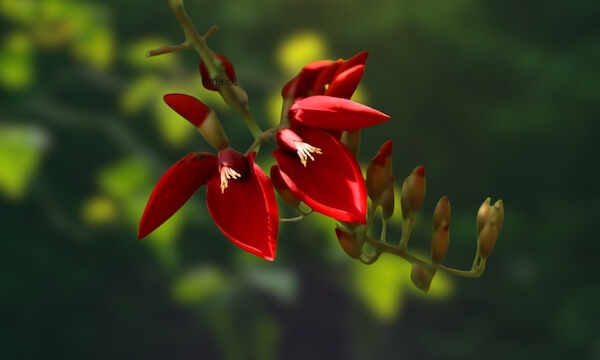 Erabadu flower
4. Before the new year begins, families clean and decorate their homes to welcome prosperity and good fortune. People often buy and wear new clothes in special colours chosen by astrologers each year. For 2026, the auspicious colour is red.
Traditional dress is a sarong and shirt for men and sarees for women.
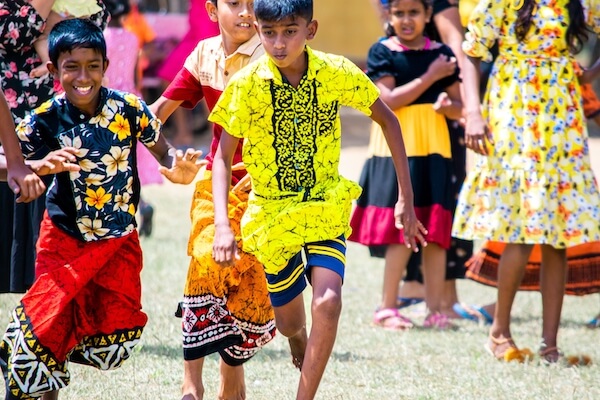 Traditional clothes worn at the new year celebrations in Sri Lanka - image by Rajitha Amajith
5. It is tradition to have a quiet period between the old year and the new year. During this time, people stop work and focus on prayer and reflection. This quiet time is referred to as "neutral period" or "nonagathe" (also spells as nonagathaya).
6. The woman of the house usually lights the cooking fire or hearth at an exact auspicious time set by astrologers. This auspicious time is called Nekath. They then cook the first meal of the new year, called kiribath, which is a milk rice.
7. Families gather to eat the first meal together and the eldest male in the family hands out mouthfuls of milk rice to all family members.
A unique new year tradition is to boil milk until it bubbles over. This is seen as a sign of prosperity and good luck for the year.
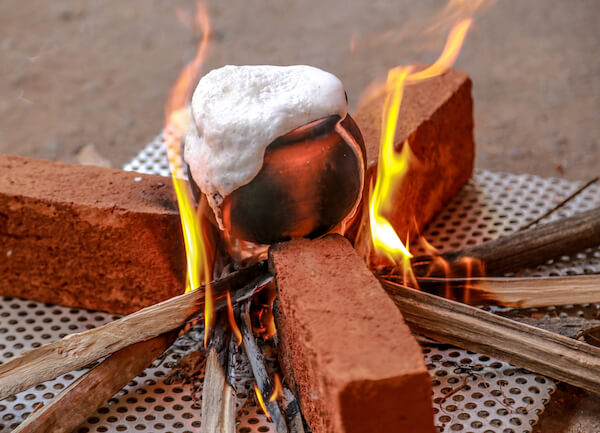 Sinhalese New Year Tradition: Overflowing Milk - image by Siyapath
8. The most important Avurudu dish is called Kiribath which is prepared and shared with family and neighbors. This is a milky rice dish is served first at every celebration. Often it is eaten with lunu miris, which is a spicy chilli paste.
Other traditional food that is shared on every Avurudu table are:
- Aasmi: These decorative and crunchy sweets are made from rice flour and coconut milk and then drizzled with caramel syrup.
- Kokis: These lacy fried snacks are also made from rice flour and coconut milk. They're made using a special mould dipped in hot oil.
- Kavum: The golden oil cakes are made from rice flour and treacle and then are fried until they are crispy on the outside and soft inside.
Can you name some of the typical Sri Lankan treats shown in the image?
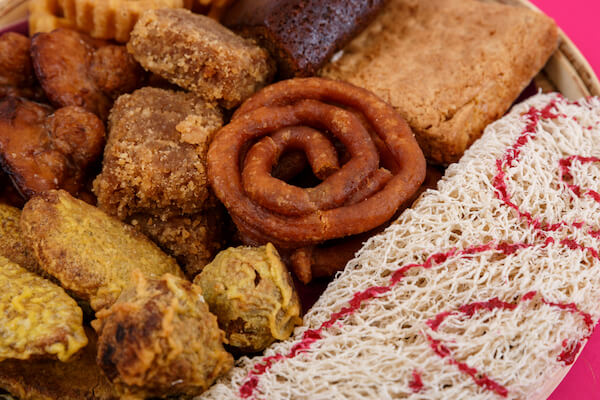 Sri Lankan festive sweets - image by Siyapath
9. Children offer betel leaves to parents and grandparents as a sign of respect and gratitude. Elders bless the children and often give them gifts of money.
Another important tradition is called "Ganu Denu" and is part of the celebrations. After sharing the first bites also money gifts are shared between family members for receiving good faith, prosperity and goodwill for the coming year
10. People also visit Buddhist temples and Hindu temples to pray and give thanks. Traditional games are also played to create unity and friendship amongst the communities' members. These games often include pillow fighting, tug-of-war and climbing greasy poles.
Find here a lovely video clip (25 minutes) about the traditional New Year celebrations in Sri Lanka.
Do you want to learn more about Sri Lanka?
Check out our fun country facts with information about the country's geo superlatives, people and culture, animals and economy and more interesting Sri Lankan food and dishes... Enjoy!
We hope you have enjoyed our Avurudu Facts for Kids and wish all our friends who celebrate a wonderful day:
"Suba Aluth Avuruddhak Wewaa! Happy New Year! May this New Year be filled with peace and happiness!"
from all of us at Kids-World-Travel-Guide.com
Sinhalese New Year Facts for Kids | Resources
- Tourism Sri Lanka. "Must Do's." SriLankaTourism. Last accessed 8 April 2026
- Elanka. "Sydney Sunfest 2026" Elanka.com.au. Last accessed 8 April 2026
- Ravi Kumara. "Me Awrudu Kaale." Song on Youtube. Last accessed 8 April 2026 - listen here
Image Credits on Sinhalese New Year Facts: Sinhalese New Year images within the essay are by Saviru's mother.
All others by Shutterstock.com and Canva.com as mentioned.
Huge Thanks again for this lovely article and the inspiration you provided, Saviru Bandara! Your contribution is so much appreciated! Well done and keep writing!
Popular Pages
 |
 |
Return from Sinhalese New Year - Facts for Kids to Kids World Travel Guide Homepage
Competition Winners 2025


Competition Winners 2024
 |
 |
 |
 |
 |
 |
 |
 |
Competition Winners 2023
 |
 |

Competition
2026

Recent Articles


-
Facts about Tuvalu for Kids: Geography, People and Wildlife
Sep 11, 26 07:15 AM
Explore our facts about Tuvalu and learn about the Polynesian island nation and its geography, people, economy, culture and animals - Worksheets included -
Animals in Norway for Kids: Wildlife Facts
Sep 03, 26 10:50 AM
Animals in Norway explained: meet reindeer, moose, polar bears, whales and puffins, with habitat facts and a short quiz for class. -
Norway Facts for Kids: Fjords, Vikings and Reindeer
Sep 01, 26 09:01 AM
Learn Norway Facts about the land of the Nobel Prize, the Vikings, reindeers, trolls and other attractions
More about
Sri Lanka
More about India
More about Countries and Territories in Asia
 Indonesia

 Nepal
Nepal

 Sri Lanka
 Thailand

Animals around the World


Food around the World
Like us
Competition 2026