Spanish People Who Shaped Spain
Explorers, Artists, Athletes, Scientists And Royals
This page introduces famous Spanish people from history, arts, science and sports as one way to learn about Spain and its culture. Spain is a country with a long and fascinating history stretching back thousands of years.
From fearless explorers who sailed to unknown worlds, to painters who changed the way we see art forever. Spain has produced some of the most remarkable people in world history.
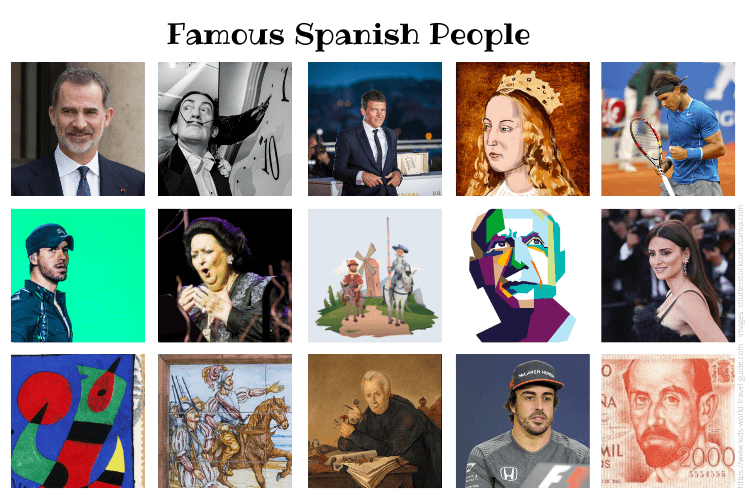
Among the most famous Spanish people many of us will have heard about are the painter Picasso, the architect Gaudí and tennis player Rafael Nadal. But there are so many other fantastic Spanish artists, sportspeople, actors, musicians and, of course, explorers and historic figures. Do you recognise some of them in this picture collage above?
Famous Spanish People
The Royals
Spain is a kingdom since the Catholic monarchs King Ferdinand II and Queen Isabella I were the first couple in an united Spain in the 15th century. Since 2014, King Felipe is the reigning King of Spain.

Spain is one of only 30 monarchies in the world. The Spanish royal family belong to a dynasty called the House of Borbón-Anjou, originally a French royal family who have ruled Spain for over 300 years.
King Felipe VI (born 1968) became king in 2014 when his father Juan Carlos I stepped down. He is married to Queen Letizia, who is a former journalist, and they have two daughters: Leonor (born 2005), who will be the future queen, and Sofía. They live in Zarzuela Palace in Madrid.
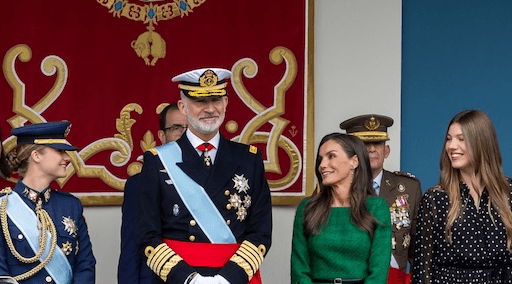 The Royal Family in Madrid 2025 - image by SportPressMedia/ Shutterstock.com
The King of Spain studied in Canada, the USA and Spain and also trained in the army, navy and air force. He speaks Spanish, Catalan, English, French and some Greek.
King Felipe VI also was a member in the Spanish Olympic sailing team in the 1992 Barcelona Olympics!
Did you know?
|
For many centuries, the area of the Iberian Peninsula, where Spain is today, was divided into separate independent kingdoms and the Muslim emirate of Granada.
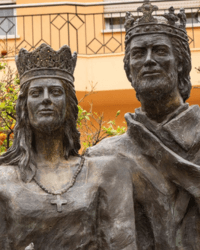 Queen Isabella I and King Ferdinand II
King Ferdinand II of Aragon (1479-1516) was the first king of Spain and is known for his efforts to unite Spain. His wife Queen Isabella I (1451-1504) is an important figure in Spain's history too.
Together they united the regions of Castille, León and Aragon into one powerful nation. The royal couple and devote Catholics were the biggest power in Europe in the 15th century. They were also responsible for expelling Jews and Muslims from the region.
King Ferdinand II initiated many reforms and financed several exploration journeys, including Christopher Columbus' voyage in 1492. This journey led to Europeans discovering the Americas and this changed the world forever!
Did you know?
|
Famous Spanish People
Explorers
In the 15th and 16th centuries, Spain was the world's most powerful empire. Spanish explorers, who were called conquistadores which means "conquerors", sailed across the oceans to explore the Americas, Asia and Africa. At its peak, the Spanish Empire covered 13% of the globe's land area!
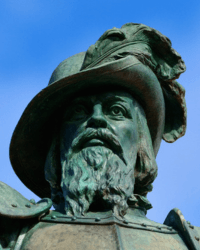
Juan Ponce de León (1460 - 1521) accompanied the Italian explorer Christopher Columbus on his second voyage to the Americas in 1493. He explored the Americas for gold and later became the first governor of Puerto Rico. He is also known for being the first European to set foot in what is today the U.S. state of Florida in the USA and chose the name "La Florida" (Land of Flowers) for the region's lush vegetation.
Hernán Cortés (1485 - 1547) was only 19 years old when he left Spain to pursue fortune across the oceans. He became one of the first conquistadores to reach Mexico where managed to overthrow the mighty Aztec Empire with his small army. He captured Montezuma, the Aztec emperor, and overthrew of the Empire of the Aztecs in 1519.
Did you know?
|
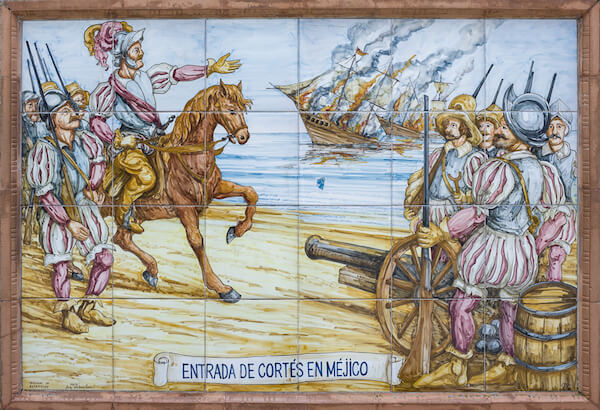 Hernan Cortez exploring Mexico
Francisco Pizarro (1478-1541) explored the western coast of South America and conquered the powerful Incan Empire of Peru in 1532. While looking for gold, he captured the Inca emperor and killed him. He destroyed the Inca state and founded the city of Lima in 1535.
Pizarro is celebrated for his bravery but also much criticised for the brutal methods he used against the Inca people.
Hernando de Soto (1500-1542) was part of an expedition to find a passage to India but landed in Nicaragua. He also lead the first European expedition deep into the North American continent and explored the regions of the states of Florida, Alabama and Georgia in the search of gold.
Did you know?
|
Spanish People
Artists and Architects
Spain has produced some of the world's most famous and revolutionary artists. Many of them knew each other and were friends. Pablo Picasso, Joan Miró, Salvador Dalí and filmmaker Luis Buñuel all knew each other as they were part of an incredible creative circle in the 1920s and 1930s.
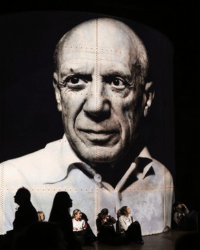 Pablo Picasso
Pablo (Ruiz) Picasso (1881-1973): Spanish designer, painter, printmaker and sculptor. Born in Málaga/ Spain, he loved drawing from an early age and attended arts school from age 13. He moved to Paris when he was 19 years old.
Picasso's art evolved in various different creative periods such as a 'Blue Period', a 'Rose Period' or a period inspired by African sculptures and masks.
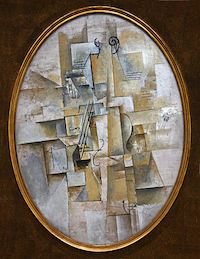 Picasso's 'Violin'
Picasso is often seen as the founder of the cubism art movement. Cubist art shows pieces of objects from different angles at once. Imagine looking at the violin in the image from the front and side at the same time! Picasso also worked with ceramics.
His most famous painting "Guernica" is known as a very powerful anti-war statement about the bombing of the Spanish town.
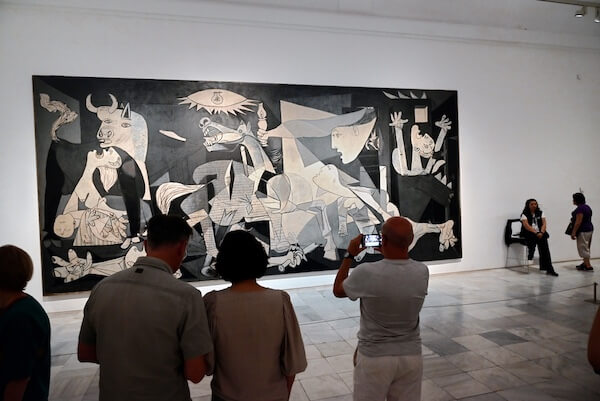 Visitors in front of Picasso's "Guernica" - image by RVillalon/ Shutterstock.com
Did you know?
|
Another famous artist who was a friend with Pablo Picasso is:
Joan Miró (1893-1983): Spanish sculptor and abstract artist and painter who enjoyed creating surrealist and fantasy artworks.
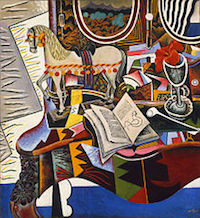 Miró 'Horse, Pipe and Red Flower'
Miró created colourful and playful paintings filled with abstract shapes, many dots and lines and even fantasy creatures. His work is full of joy and vivid imagination.
A close friend of Picasso, he also was deeply affected by the Spanish Civil War (1936–1939) and this time is represented in some of his darker artworks.
The "Big Three" of the Spanish Arts are Picasso, Miró and Dalí. They were all born in Spain and spent a considerable amount of time in France and influenced heavily the contemporary art movement.
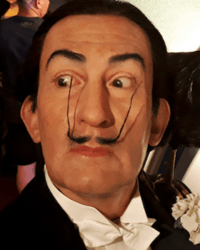 Salvador Dalí
Salvador Dalí (1904-1989): This Spanish painter is also known for his surrealist artworks. He is known for his wild imagination and created fantastic dreamlike paintings.
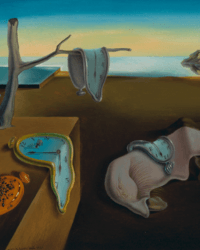
One of his most famous works is this iconic painting with the clocks melting in a desert called 'The persistence of memory'. He also painted watches big as trees, elephants with spider legs or floating figures. Dalí is quite easily recognisable due to wearing his unique upturned wiry moustache!
Much earlier than the "Big Three", one official painter to the Spanish royal family, was influencing artist in the 18th century:
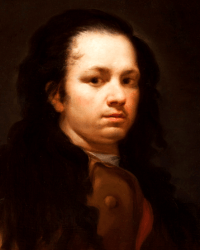
Francisco de Goya (1746-1828) was a romantic painter and printmaker. He was a royal painter and developed his style further during the Spanish Age of Enlightenment. Goya is most remembered for the fourteen 'Black Paintings' that he painted as murals on the walls of his house. They show terrifying visions and are said to reflect his own struggles with illness and experiences of war.
His work bridged the Romantic era and the modern age, influencing artists for centuries.
Another famous Spanish creative, Antonio Gaudí didn't paint, but he designed the most magic buildings!
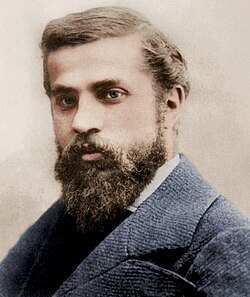 Antoni Gaudí
Antoni Gaudí (1852-1926): was a magnificent architect and decorator who started the Modernism movement in Spain. You can experience many of his great works in Barcelona, the unique Casa Battló, the fascinating Parc Guëll or the Cathedral Sagrada Família, that was started in 1882 and is still being built today!
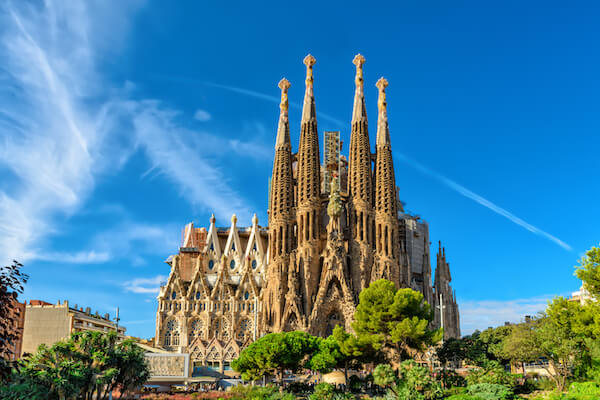 Sagrada Familia
Gaudí was deeply religious and said he was building the Sagrada Família cathedral for God.
His extraordinary buildings in Barcelona look like something from a fairy tale! They have many curved and twisting shapes, are in vivid colours and do not have straight lines. Seven of his buildings are part of the UNESCO World Heritage. His works was influenced by Gothic art and moved then into Modernism. Gaudí lived so simply that when he was hit by a tram on his way to work and died, people first mistook him for a beggar.
Famous Spanish People
Musicians and Composers
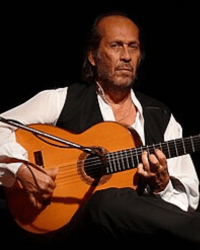 Paco de Lucía
Paco de Lucía (1947-2014) is widely recognised as a the greatest Spanish Flamenco guitarist and composer. His birth name is Francisco Sánchez Gómez, while 'Paco de Lucia' (meaning: son of Lucia) is his chosen stage name. He recorded his first songs when he was just 14 years old and one year later he started to write and compose his own songs.
Flamenco is a deeply emotional style of Spanish music, song and dance from the Andalusia region. Paco brought it to audiences all around the world.
Did you know?
|
Julio Iglesias (born 1943) is often referred to as the father of Latin pop music. He has sold over 300 million albums and is among the best-selling musicians in history! His son Enrique Iglesias (born 1975) followed in his footsteps and is a famous singer and songwriter as well. Among his most powerful songs are "Hero" and "Bailando" ("Dancing").
Montserrat Caballé (1933-2018): one of the greatest opera singers of all time. The soprano is known for her part in the famous song "Barcelona" that was the official anthem of the Barcelona Summer Olympics in 1992. Caballé created and recorded the song with former Queen singer Freddie Mercury.
Manuel de Falla (1876-1946): Spanish pianist and composer who lived in France, Spain and Argentina. He won various awards, among them several for his opera "La vida breve" or in English "Life is short".
Famous Spanish People
Scientists and Inventors
Francisco Hernández de Toledo (1514-1587), a Spanish explorer and botanist, led the first scientific journey to the Americas. He studied and collected medicinal plants in Mexico and documented over 3,000 plants, among them the first written account of the vanilla plant as well as many varieties of cacao, tomatoes and corn.
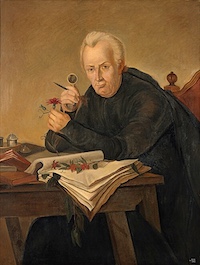 José Celestino Mutis
José Celestino Mutis (1732-1808): A famous Spanish monk and botanist, artist and mathematician. He led expeditions in Colombia and studied the flora of the country as well as various indigenous languages. He was a friend of German geographer Alexander von Humboldt. Mutis' work helped map the incredible biodiversity of South America for the very first time.
Emilio Herrera Linares (1879-1967) an aerospace engineer was the inventor of the forerunner of the first space suit. This stratospheric space suit was an articulated metal framed with a watertight cover and had accordion-like folds for moving the shoulders, elbows, knees, fingers and hips. The suit had helmet with visors and was supplied with pure oxygen and included an electric heater in the suit. It was tested in a hot-air balloon but a flight to the stratosphere never happened.
Leonardo Torres Quevedo (1852–1936) a Spanish civil engineer and mathematician invented the first remote control in the early 20th century. He is best known for inventing the "Telekino" which is an early radio control system, the Whirlpool Aero Car, a cable car above the Niagara River's Whirlpool, and El Ajedrecista (The Chessplayer), one of the first automated chess-playing machines in the world.
Famous Spanish People
Authors, Writers and Poets
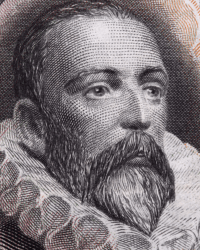 Miguel de Cervantes
Miguel de Cervantes (1547-1616) is one of the most famous Spanish writers. He is the author of 'Don Quixote', written in 1605, which is widely considered the first modern novel. It tells the story of a man called Don Quixote who reads so many stories about knights and adventures that he believes he is a knight and sets off on a quest! He becomes so obsessed with his fight against evil that he attacks windmills believing they are giant monsters. 'Don Quixote' is one of the most translated books in Spanish literature.Cervantes lived in Spain and Italy.
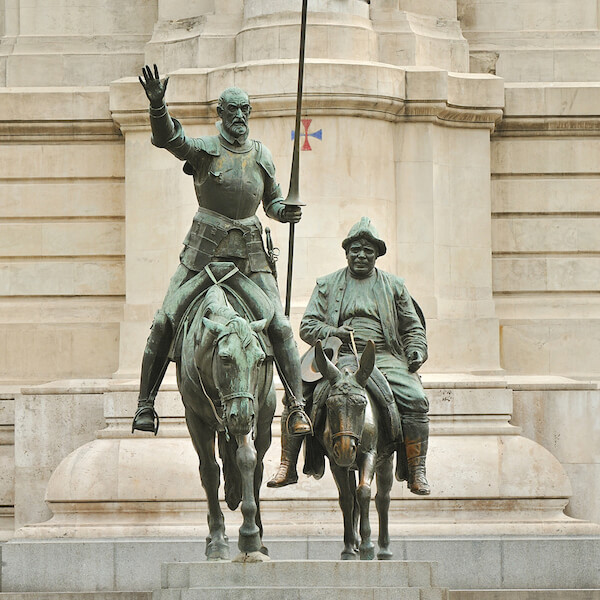 Statue of Don Quixote and Sancho Panza in Madrid
Did you know?
|
Federico García Lorca (1898-1936): Spanish poet and playwright who wrote passionate poetry and plays that celebrated Spanish folk culture. He studied literature and law at Uni and was a friend of composer Manuel de Falla, film director Louis Buñel and painter Salvador Dalí. He was killed during the Spanish Civil War at just 38 years old.
Juan Ramón Jiménez (1881-1958) Spanish author and poet who was awarded the Nobel Prize in Literature in 1956 for his modern 'pure' poetry. He is best known for his charming prose poem "Platero and I" which is a tale about a writer and his donkey.
Famous Spanish People
Athletes and Sporting Legends
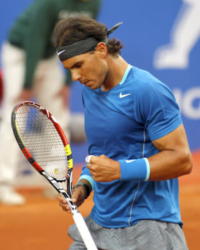 Rafael Nadal
Rafael Nadal (born 1986): The professional tennis player is one of the highest ranking tennis players ever and has won 22 Grand Slam titles. Nadal was born on the island of Mallorca and won his first regional tennis championships when he was just eight years old.
Nadal is nicknamed the "King of Clay" as he won the French Open a record 14 times!
Sandra Sánchez Jaime (born 1981): The karate champion won a gold medal in the women’s karate kata event at the Tokyo 2020 Olympics. Sandra holds the Guiness World Record for the most medals ever won in the Karate 1 Premier League that is held annually in Paris and Istanbul. She is an inspiration for young martial artists around the world!
Fernando Alonso (born 1981): The Formula One racing car driver started driving go-kart races as a young child. He won his first junior championship races when he was seven years old. At age 24, he was the youngest F1 champion at that time (2005) and he also won the world championships in 2006. He is one of Spain's most celebrated sportspeople.
David de Gea (born 1990): The soccer goal keeper was playing for Manchester United is now playing for Fiorentina in Italy.
Did you know?
|
Famous Spanish People
Actors | Directors
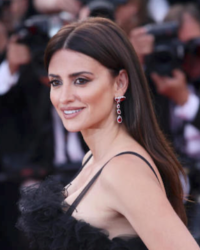 Penelope Cruz
Penélope Cruz (born 1974): Spanish actress and model was the first Spanish actress to get a star on the Hollywood Walk of Fame. She played in many films including 'Pirates of the Caribbean'
Antonio Banderas (born 1960): Spanish actor, director and singer won various Golden Globe awards, Academy awards and is one of the most celebrated actor. He played in various Hollywood films such as "Zorro" and films of Spanish director Pedro Almodovar (born 1949).
Learn more about Spain
 |
 |
 |
 |
Resources for Famous Spanish People
- Anne Umland/ The Museum of Modern Art. "Cubism for Kids: An Art Treasure Hunt at MoMA". MoMA. 18 April 2024. Last accessed 13 May 2026
- The European Museums Network. "Daily art story: Salvador Dalí and the sacred moustache" Museums.EU. Last accessed 13 May 2026
- Casa Battló. "Works of Antoni Gaudí". CasaBattlo.es Last accessed 13 May 2026
- Jessica Jones. "Seven Spanish Musicians the World Needs to Know." CultureTrip. 25 July 2017. Last accessed 13 May 2026
- Voorhies, James. "Francisco de Goya (1746–1828) and the Spanish Enlightenment." In Heilbrunn Timeline of Art History. New York: The Metropolitan Museum of Art. October 2003. Last accessed 13 May 2026
- FIFA. "Latest Men's World Ranking." FIFA. Last accessed 13 May 2026
Images for the Famous Spanish People Collage: From shutterstock.com:
King Felipe VI in 2020 by Frederic Legrand - COMEO; Dali by Olena Z; Antonio Banderas by taniavolobueva; Queen Isabella from wikicommons; Rafael Nadal by maxisport; Enrique Iglesias by Ben Houdijk; Montserrat Caballe by ToskanaINC; Don Quixote by; Picasso by SMD90; Penelope Cruz by Denis Makarenko; Miro by irisphoto1; Hernan Cortez by Juan Aunion; Mutis painting by R. Cristobal; Fernando Alonso by PatrickLauzon photographs; Jimenez banknote by José María Cruz Novillo
Other images:
Queen Isabella by wikicommons; Don Quixote from shutterstock and Spanish royal family by zixia/shutterstock; wjarek/shutterstock.com and spatuletail/ Shutterstock.com
Competition
2026
Recent Articles


-
Facts about Tuvalu for Kids: Geography, People and Wildlife
Sep 11, 26 07:15 AM
Explore our facts about Tuvalu and learn about the Polynesian island nation and its geography, people, economy, culture and animals - Worksheets included -
Animals in Norway for Kids: Wildlife Facts
Sep 03, 26 10:50 AM
Animals in Norway explained: meet reindeer, moose, polar bears, whales and puffins, with habitat facts and a short quiz for class. -
Norway Facts for Kids: Fjords, Vikings and Reindeer
Sep 01, 26 09:01 AM
Learn Norway Facts about the land of the Nobel Prize, the Vikings, reindeers, trolls and other attractions
More about Spain
More about Countries in Europe
More about Countries in
South America
Food around the World




Do you like what you read?

|
Copy and paste into mails and onto your website, blog or Facebook page: <a href="https://www.kids-world-travel-guide.com/spanish-people.html">Kids World Travel Guide: Famous Spanish People</a> |
Competition 2026