Facts about Andorra
for Kids
Andorra for Kids
Imagine a country high in the mountains where you can ski in winter, hike in summer, and drive across the whole country in under an hour! Welcome to Andorra!
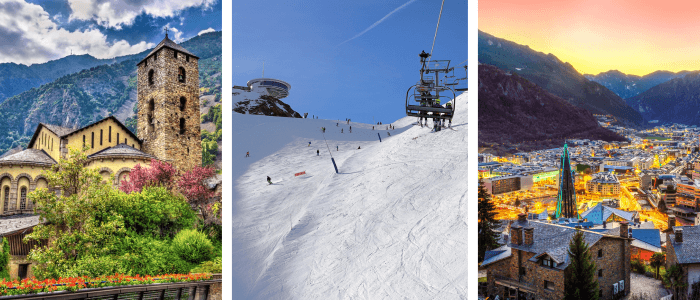 Impressions of Andorra: Sant Esteve, Skiing, Andorra La Vella
What you will find on our page about Andorra:
Here are the most interesting Facts about Andorra which were chosen and researched by kids especially for kids.
Andorra - Snapshot
|
Andorra - Basic Facts
- Continent: Europe
- Population: 79,000 people live in Andorra
- Capital: Andorra La Vella
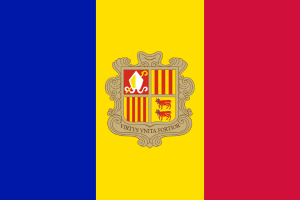 Flag of Andorra
- Name: Principality of Andorra (Principat d'Andorra)
- Government: Co-Principality
- Official Language: Catalan
- Religion: 90% Christians (mainly Roman Catholics)
- Currency: 1 Euro = 100 cents
- National symbols: Pyrenean chamomile (national flower), Lammergeier (national animal)
- Coat of arms: Shows the Spanish Bishop's mitre, the French royal cows, the Catalan stripes and the Foix castle (in France).

- History: In 9,500 BCE there were already seasonal mountain camps by hunter-gatherers in this region. The first permanent camp was in 6,640 BCE. Romans, Goths and the Franks settled in the area. Charlemagne is said to have founded the country as he gave the land to the Bishop of Uguell in Spain as a buffer between Spain and France. A co-principality was established in 1278. In 1993, the first constitution was set.
- National Day: 8 September (La Diada de Meritxell)
- Heads of State: Emmanuel Macron (President of France) and Josep-Lluís Serrano Pentinat (Bishop of Urgell/ Spain)
- Head of Government: Xavier Espot Zamora (since 2019)
Facts about Andorra
Andorra Map | Where is Andorra?
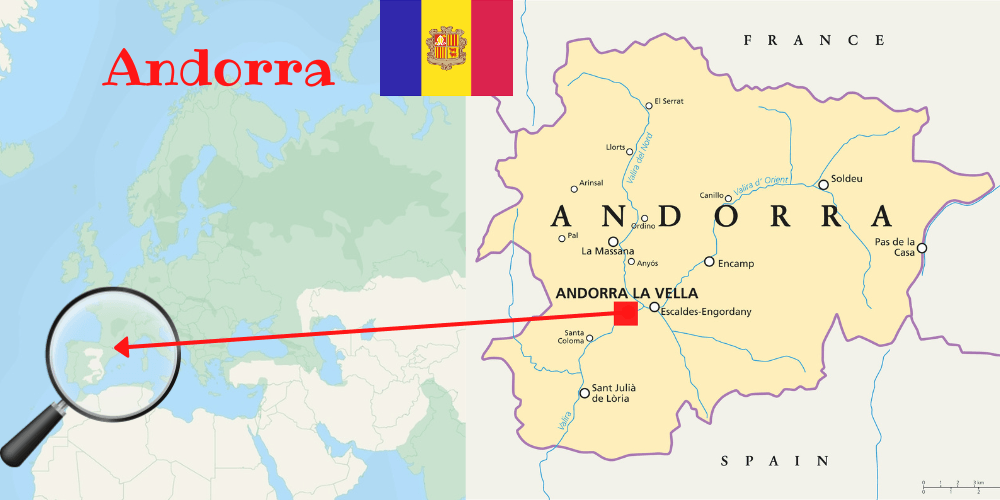 Andorra maps
Andorra is a landlocked country in southwestern Europe. The small country is located in the eastern Pyrenees mountains between France and Spain.
The country has over 65 peaks that are higher than 2000 m/ 6,562 ft above sea level. Andorra is the highest country in Europe with an average elevation of Andorra is 1,996 metres/ 6,549 ft.
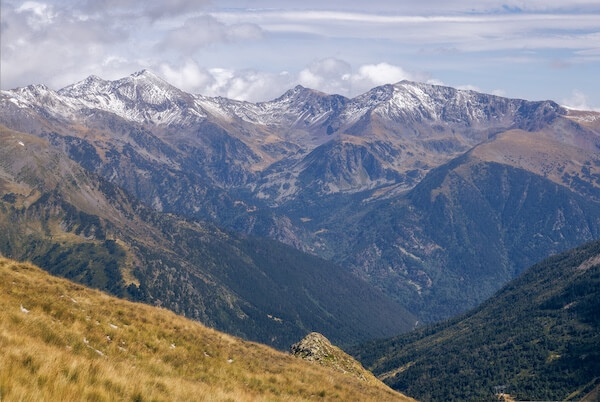 Pyrenees - image by Peresanz/ Shutterstock.com
More than 90% of the territory is covered by rugged mountains and dense forests, rivers, lakes and meadows while only 8% are cities, towns and villages.
Andorra is one of Europe’s six microstates. It is the largest of the six: Andorra, San Marino, Malta, Vatican, Monaco, and Liechtenstein.
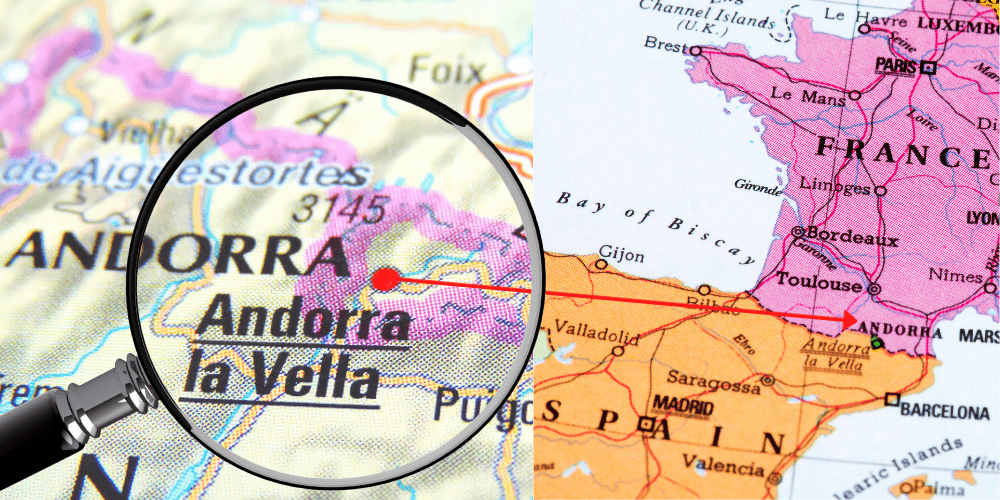 Andorra, largest of the European microstates
Most residents live in urban areas. The capital is Andorra la Vella, which is also the largest and most densely populated city in the country.
Did you know?
|
Andorra is about the same size as the Isle of Man or a quarter of the county of Lincolnshire.
Facts about Andorra
Geography Superlatives
- Andorra is the smallest country within the European Union (EU)
- Andorra the highest lying inhabited country on the European continent with an average elevation of 1,996 metres/ 6,549 ft.
- Andorra la Vella is also the highest capital city of the European continent at 1,023 m/ 3,356 ft above sea level.
- The longest and largest river of Andorra is the Gran Valira river which flows through the capital city Andorra la Vella into Spain.
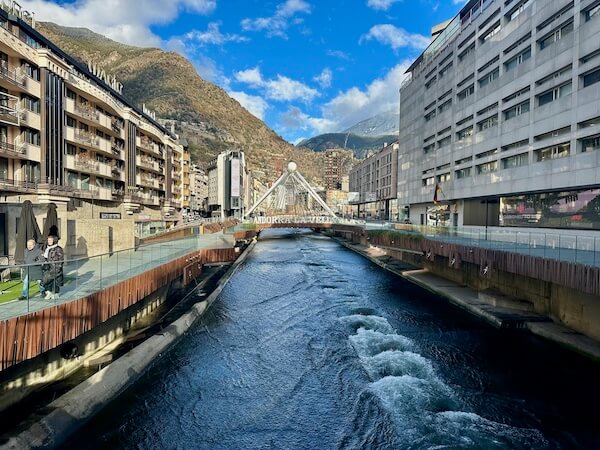 Gran Valira River - image by Carolyne Parent/ Shutterstock.com
- The highest mountain of Andorra is Coma Pedrosa, which rises to 2,946 m / 9,665 ft.
- Andorra has a very unusual system of government. Andorra is the only sovereign country called a "co-principality". There is an elected head of government, a prime minister but there are also two heads of state, known as "Co-Princes": the President of France and the Bishop of Urgell in Spain share power equally in their honorary positions.
Did you know?
|
- Andorra has more than 15 museums despite its small size, only the Vatican has more museums for this space! From an ancient forge to displays of modern art, from post museums to motorcycle museum, there are fascinating museums for every interest.
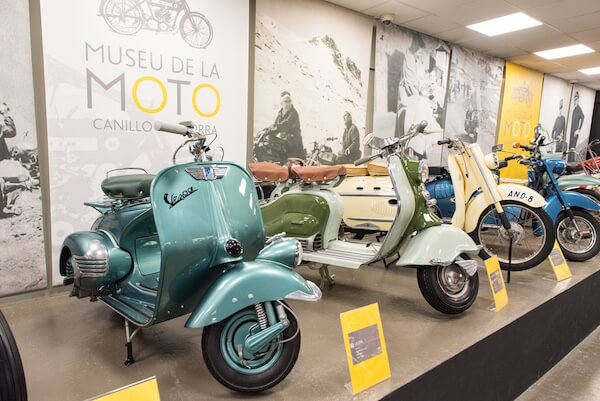 Moto Museum in Andorra - image by Martin SC Photo/ shutterstock.com
- The country’s Madriu-Perafita-Claror Valley covers more than 9% of the land area of Andorra. This UNESCO World Heritage Site is the largest continuous territory of any countries in the world and covers an unique glacial landscape with glacier lakes and rocky mountains with steep cliffs and a narrow but lush valley with a spectacular gorge.
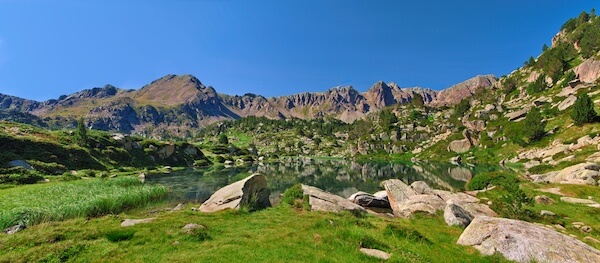 Madriu-Perafita-Claror Valley
Facts about Andorra
Climate in Andorra
Andorra has four clearly defined seasons and different microclimates as the land rises from around 800 m/ 2,600 ft to almost 3,000 m/ 9,800 ft above sea level.
Generally conditions are milder and warmer in the valleys that in the higher mountain regions. The Pyrenees mountains also work as a barrier and trap air and force it to rise, which leads to more rainfall in some valleys and snow in higher areas as well as sheltered valleys. Some of these valleys are sunny and warm while others nearby might be colder as they are more shaded. This creates local weather differences even between nearby villages.
Temperatures typically range from 15°C to 25°C/ 59°F to 77°F in summer and can go down to -5°C/ 23°F or lower in winter, when there is also much snow and frost.
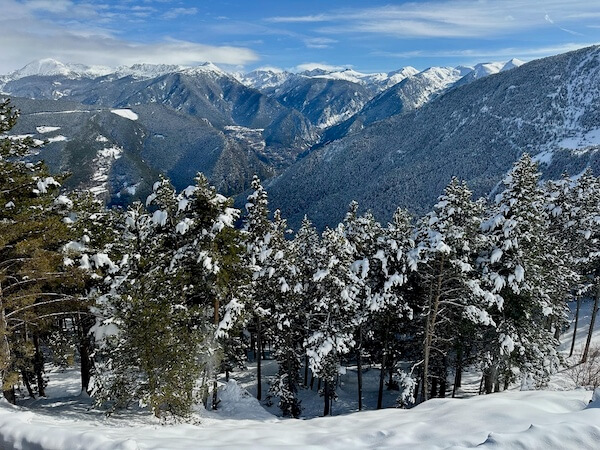 Andorra in winter - image by Carolyne Parent
Rainfall can occur throughout the year, with spring and autumn receiving most of the rain.
Andorra is highly vulnerable to climate change as average temperatures in the high mountains rise continuously. Over the last ten years, temperatures have risen while snowfall has decreased. As the amount of snow is receeding and the snow line retreats, this has a huge impact on skiing tourism!
Facts about Andorra
Landmarks and Attractions
Andorra’s historical roots trace back to the Roman era and there are also many man-made landmarks highlighting Gothic, Baroque and Romanesque styles.
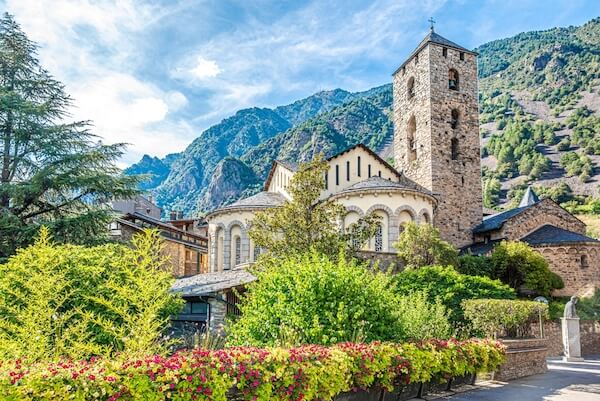 Saint Esteve built in the 11th and 12th century
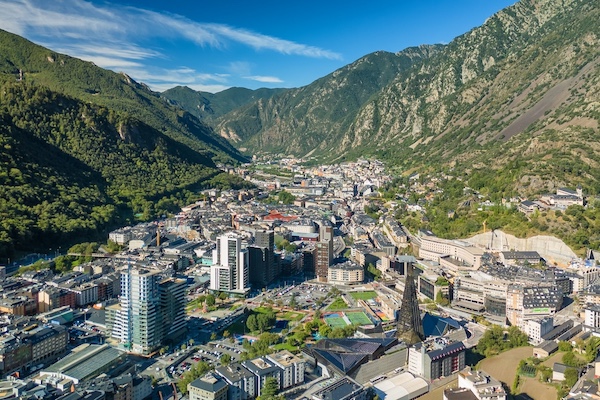 Andorra la Vella - Capital city of Andorra
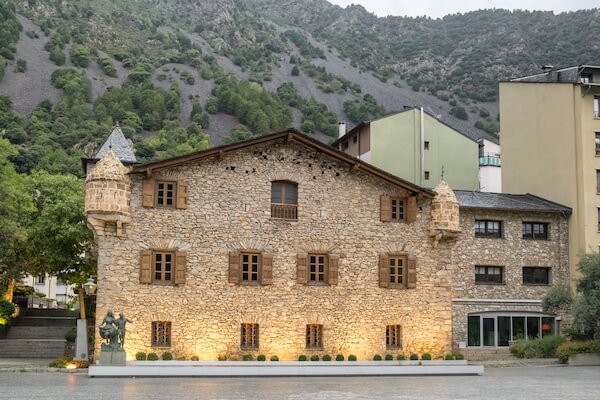 Casa de la Vall from 1580 - medieval parliament building
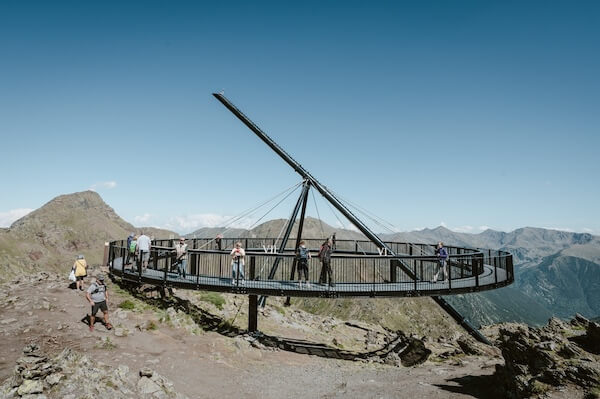 Tristaina Solar Viewpoint
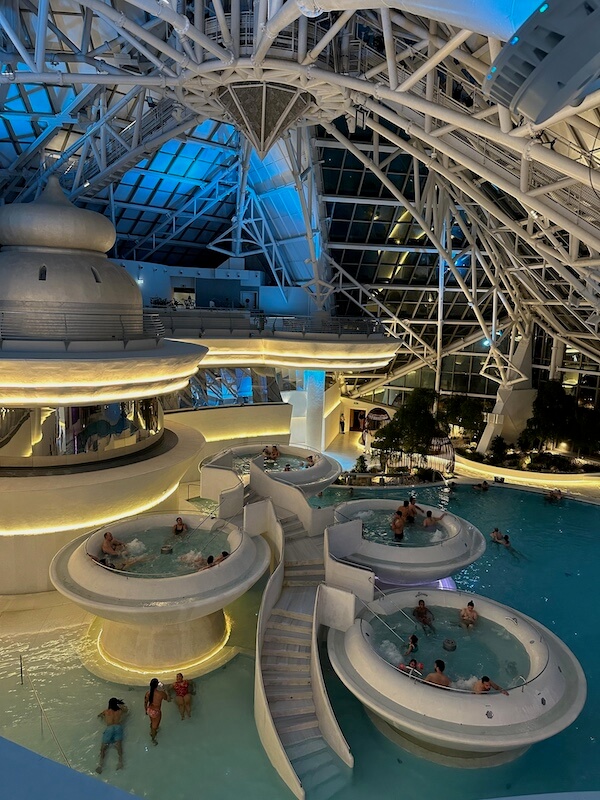 Caldea Spa - image by Carolyne Parent/ Shutterstock.com
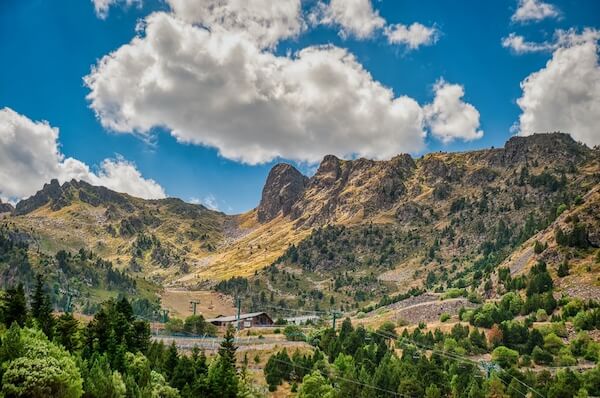 Ordino - image by Joan Vadell
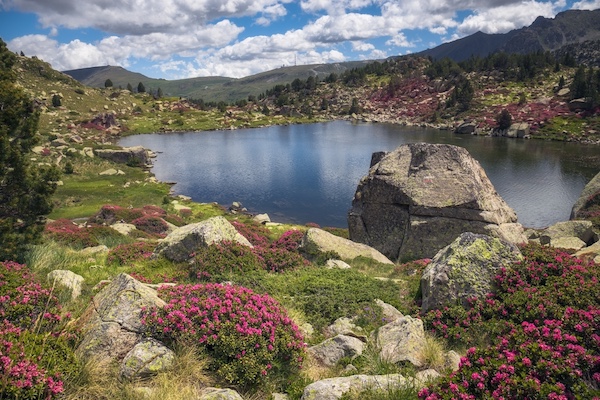 Estany de Pessons - glacial rock formations
Last but not least: A unique attraction for families are the wooden Tamarros sculptures in the forests of Andorra. The Tamarros are based on mythical creatures from Pyrenean folklore. Read more here.
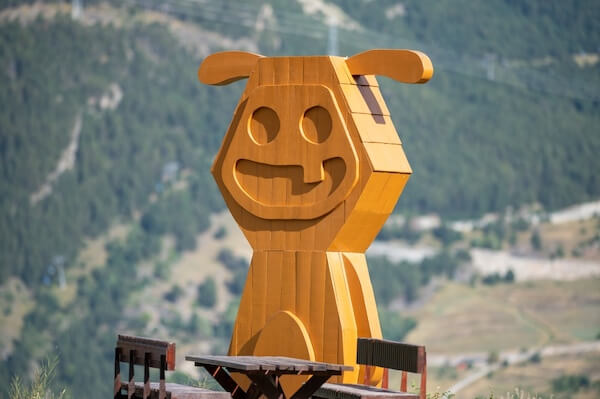 Wooden "Tamarro"
Facts about Andorra
History
The region of today’s Andorra was already settled in 9,500 BCE as a seasonal mountain camp by hunter-gatherers. The first permanent camp was built around permanent camp in 6,640 BCE in the Valley of Madriu. Romans are known to have been in the area from the second century BCE to the fifth century CE. During the Kingdom of the Goths and the Franks, Christiany was spread.
Andorra is believed to have been created already by Charlemagne and later granted to the Count of Urgell in Spain and through the count to the Bishop of Urgell in 1133. From 1278, the country was ruled as a co-principality.
While France and Spain both tried to control the Pyrenees over the years, Andorra remained independent and a buffer zone between the neighbouring countries. It also was an important place on the smuggling route between Spain and France during WW2. In 1993, Andorra adopted its first own constitution and became a member of the UN.
Did you know?
|
Andorra’s parliament is the General Council which is composed of 28 members that are elected by the population every 4 years.
Facts about Andorra
People and Culture
Around 79,000 people live in Andorra. Compared to the UK or the USA, fewer people live in Andorra than in the cities of Croydon or Luton in the UK or in Santa Monica in California/ USA!
Most Andorrans are Catholics.
Among the most important festivals in Andorra is the midsummer festival on the day of "Sant Joan" (Saint John) on 23 June. On Saint John's Eve, bonfires are lit on mountain tops, and young people jump over flames. This is an ancient tradition still practised today in many countries for midsummer! The traditional torch bearers (called fallaires) display their skills in swinging their torches which marks the beginning of summer. Children participate in the "Falles de Llum" (Light Falles), they swing balls with lights to learn the tradition before moving on to real fire.
Andorra's national day, Diada de Meritxell, is an important celebration and takes place on 8 September. The day celebrates the country’s patron saint Our Lady of Meritxell. Families gather at the Meritxell Sanctuary for ceremonies, traditional dances, music and feasts.
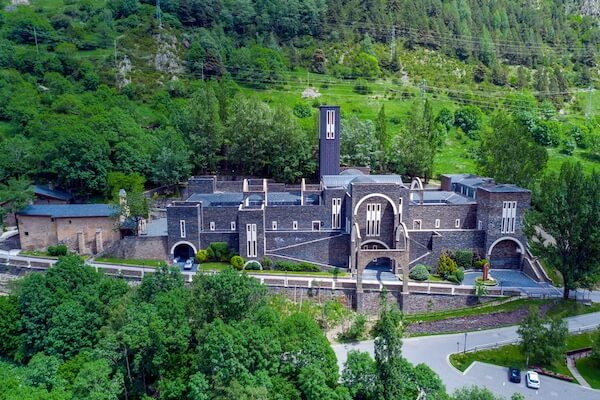 Meritxell Sanctuary - Reconstructed Church (from the 12th century) that burnt down in 1972
The original chapel of Meritxell Sanctuary burnt down in a fire in 1972, however, a new very modern chapel was built by famous Spanish architect Ricardo Bofill.
Andorra's traditional folk dance is called El Contrapàs. This dance is performed in a circle during celebrations. El Contrapàs is much slower and more solemn than traditional French or Spanish dances. Another traditional dance is the Sardana. People hold hands and move together in a circle. This is a strong symbol of equality and unity as there is not one person leading and as such this dance is a powerful symbol of Catalan identity and pride.
Andorra's most popular sport is skiing.
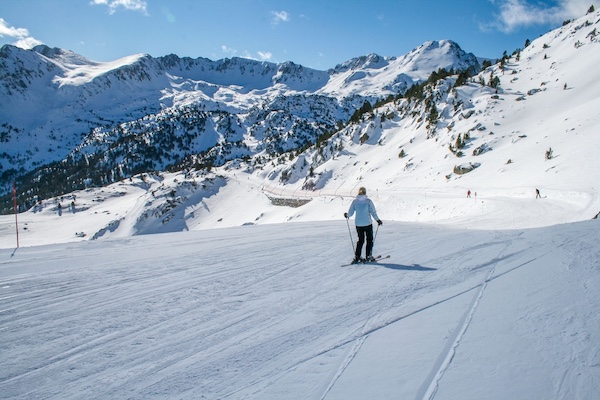 Skiing in Andorra
Language in Andorra
Andorra's official language is Catalan which is used by the government, in education and in the media. Catalan is also spoken in parts of eastern Spain and southern France. Almost half of the population consider Catalan as their first language in Andorra.
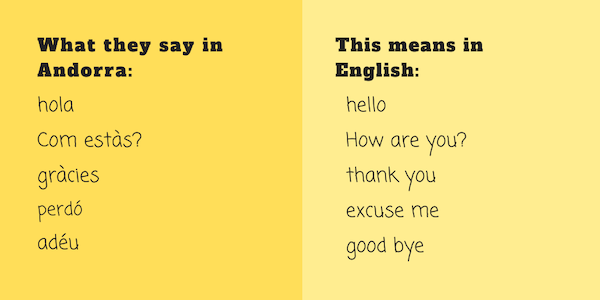
In fact, Andorra is quite multilingual as you can hear Catalan, Spanish, French and English spoken throughout the country. English is taught in many in the local schools, so people are familiar with the language at an intermediate level.
Andorra has one university, but many young Andorrans go to France or Spain to study, and many later return home to work in their home country.
Andorra Facts
Food
Escudella, a meat and vegetable stew, is considered the national dish.
Andorra produces a variety of mountain cheeses, especially from goat and sheep milk. Cheese is often paired with local honey and served on wooden boards as a snack.
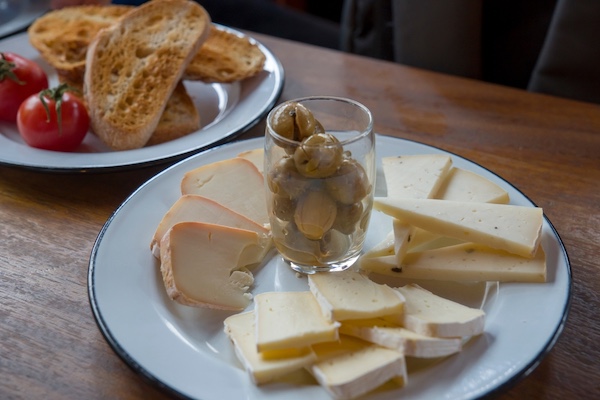 Andorran snacks and cheese platter
- Escudella: This one-pot stew was traditionally an everyday dish and made with whatever products, rice and vegetables were held in the pantry. Meat was only added for special occasions and celebrations. However today, most often Escudella is made with pork or lamb meat and bacon. This thick soup is especially popular in winter. Snail shaped pasta is often used in this dish too. This dish is very popular during the cold Pyrenean winters. Find an Escudella recipe here.
- Trinxat: A simple dish made with mashed potato, cabbage and bacon or pork crackling. This dish is sometimes referred to as the "Andorran bubble and squeak."
- Truita de carreroles: An omelette made with wild mushrooms that have been foraged from the mountain forests. Foraging (collecting wild food) is a proud local tradition in Andorra.
- Caragols a la llauna: This dish of fried and baked snails consists of medium-sized bover snails, that are boiled with an array of spices including bay leaf, thyme, mint and pepper and then baked or fried.
- Coca masegada: traditional rustic flat breads made with flour, milk and egg and some other sweet or savoury ingredients
Facts about Andorra
Economy
Andorra gave up on farming as its main industry a long time ago. The steep mountain terrain makes farming very hard. Andorra's only significant agricultural export is tobacco that is still grown on the hillsides.
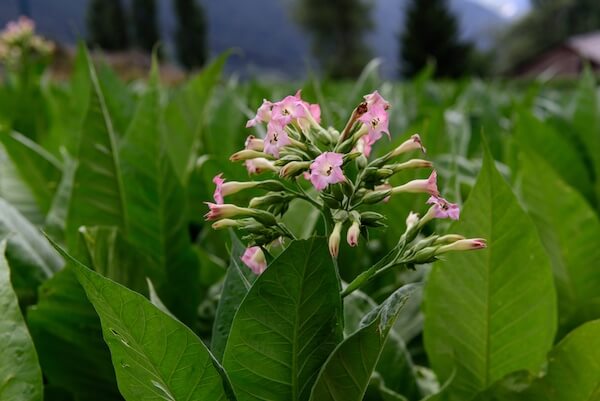 Tobacco plant
The main economic sectors in the country are tourism, trade and banking.
Winter skiing brings huge numbers of visitors to Andorra. Ski resorts, hotels and restaurants employ a large portion of the population.
Andorra was a tax haven and had no personal income tax until 2013. Today, it still has the lowest value added tax in Europe! Most shopping only carry 4.5% sales tax (IGI - General Indirect Tax) in Andorra and as such the country is a famous shopping destination for cheap electronics, perfume and alcohol. Neighbouring countries Spain and France have 20% tax on goods (VAT – value added tax)!
Andorra's low tax rates mean electronics, perfume, alcohol and cigarettes are much cheaper than in France or Spain.
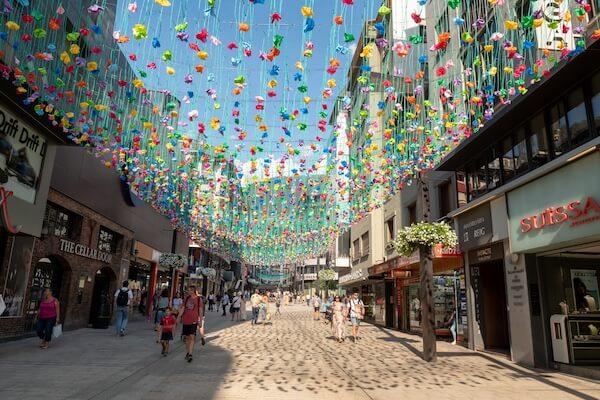 Shopping in Andorra - image by MartinSCPhoto Shopping in Andorra - image by MartinSCPhotoDid you know?
|
Andorra was historically known as a secretive banking centre, just like Switzerland. But to meet European standards, Andorra has modernised its banking laws. Andorra uses the euro (€) but isn't in the European Union. It has a special agreement to use the euro, and even mints its own euro coins. Before 2001, Andorra used both currencies, the Spanish peseta and the French franc.
Andorra has a high-quality healthcare system that covers about 92% of the population and is ranked among the best in Europe. Andorra has a high standard of living and one of the highest life expectancies in the world.
Facts about Andorra
Wildlife
In the Andorran natural parks you can find Pyrenean chamois, mouflons, alpine marmots and deer, weasels and rock lizards, golden eagles and bearded vultures among many other species.
Pyrenean chamois are easily spotted at high altitude where the mountain goat-antelope leaps between rocky cliffs.
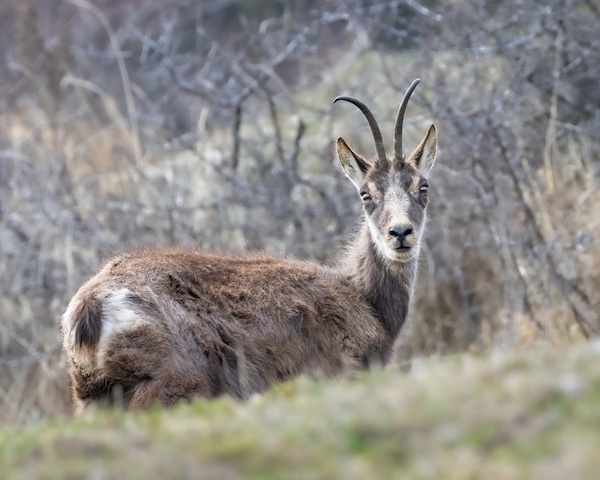 Chamois
The rate brown bear which is one of Europe's rarest large mammals can sometimes be seen in Andorra's forests. Trouts and frogs can be found in and around many streams while the Pyrenean brook salamanders are highly endangered.
The national bird of Andorra is the lammergeier, a species of bearded vulture. It was nearly extinct in the Pyrenees, but fortunately now make a comeback.
Did you know?
|
Over 1,000 plant species have been recorded in Andorra. Silver fir and Scots pine, as well as alpine wildflowers such as gentians, edelweiss and wild orchids, thrive on the higher mountain slopes, while oak trees and herbs such as chamomile, thyme and juniper are found in lower areas.
Facts about Andorra
FAQs
1. Where is Andorra?
Andorra is a small country in southwestern Europe, high in the Pyrenees mountains between Spain and France.
2. How big is Andorra?
Andorra is very small. You can drive across it in less than an hour!
3. What is special about Andorra’s capital city?
Andorra la Vella is the highest capital city in Europe.
4. What language do people speak in Andorra?
The official language is Catalan, but many people also speak Spanish, French and English.
5. Why do so many tourists visit Andorra?
People come for skiing in winter, hiking in summer and shopping because taxes are low.
6. What is the national animal of Andorra?
The lammergeier, a bearded vulture, is the national animal. The large bird drops bones from the sky to break them open!
7. Is Andorra part of the European Union?
No, Andorra is not in the EU, but it still uses the euro as its currency.
8. Why does Andorra have two leaders?
Andorra is a co-principality, which means it has two heads of state: the President of France and a Spanish bishop.
Facts about Andorra
Note For Teachers
In a world of large countries that dominate the news, Andorra reminds us that small places can have big stories too. They show us geography shapes how people live, who they are and what they value.
Why Andorra matters?
In one tiny country you get mountain geography, medieval history, European politics, economic geography, biodiversity, cultural identity and tourism all together. This is almost like a field trip that covers the whole KS2/3 curriculum!
Please subscribe to our site to access the teachers notes.
Popular Pages
 France for Kids France for Kids |
 Spain for Kids Spain for Kids |
 |
 |
 |
 |
Facts about Andorra for Kids
Useful Resources
- Central Intelligence Agency. "Spain". The WorldFactbook. Last updated 17 January 2024. Last accessed 22 January 2024
- "The Children's Visual World Atlas". Fog City Press. Sydney 2004
- Madrid Official Tourism Info. "Madrid for Kids". Visit Madrid. Last accessed 22 January 2024
- Don Quijote. "Conversational Spanish". donquijote.org. Last accessed 22 January 2024
- Travel + Leisure. "16 of the Best Beach Cities in Europe". Travelandleisure.com. 19 April 2017. Last accessed 22 January 2024
- Christian López. "Liquid Gold? Not for Spanish olive growers struggling to survive". El Pais. 22 July 2019. Last accessed 22 January 2024
- Spain Tourism Official. "Geography and Landscape." spain.info Last accessed 22 January 2024
Images on Facts about Andorra for Kids: shutterstock, sxc.hu, wikicommons and own images.
Please continue to share your info and expand this Facts about Andorra for Kids section. Your support is much appreciated. Contact us here for any collaborations, additions or corrections.
Enjoy learning more great Andorra Facts soon!
Return from Facts about Andorra to KidsWorldTravelGuide Homepage
Competition
2026

Recent Articles


-
Facts about Tuvalu for Kids: Geography, People and Wildlife
Sep 11, 26 07:15 AM
Explore our facts about Tuvalu and learn about the Polynesian island nation and its geography, people, economy, culture and animals - Worksheets included -
Animals in Norway for Kids: Wildlife Facts
Sep 03, 26 10:50 AM
Animals in Norway explained: meet reindeer, moose, polar bears, whales and puffins, with habitat facts and a short quiz for class. -
Norway Facts for Kids: Fjords, Vikings and Reindeer
Sep 01, 26 09:01 AM
Learn Norway Facts about the land of the Nobel Prize, the Vikings, reindeers, trolls and other attractions
***
More about Countries in Europe
Fun Facts
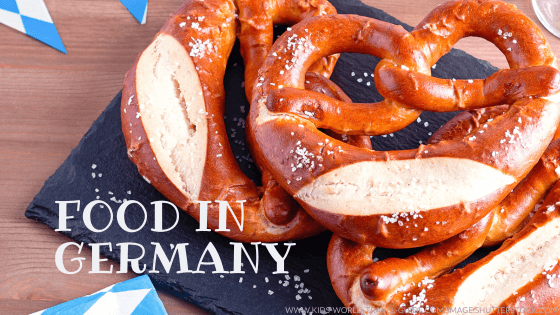
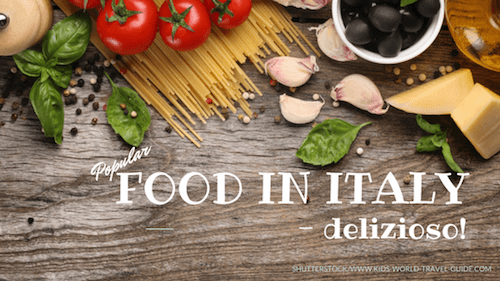
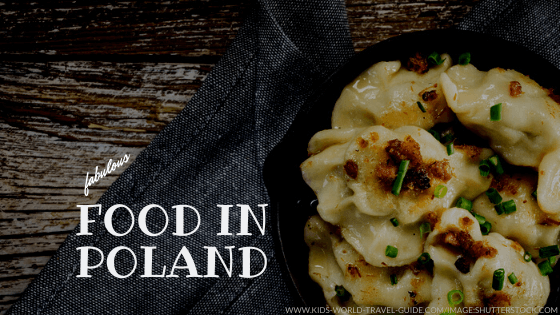
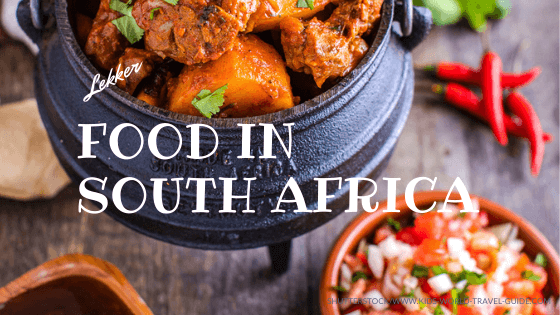
Food around the World










Like what you read?

|
Would you like a link to share the information with your friends, fans and readers? Simply use the html code below. Copy and paste onto your website, blog or Facebook page: <a href="https://www.kids-world-travel-guide.com/facts-about-andorra.html">Kids World Travel Guide: Facts about Andorra</a> Thank You for spreading the word:-) |
Like us
Competition 2026