- Homepage
- Mauritius
Mauritius Facts
Interesting Facts for Kids
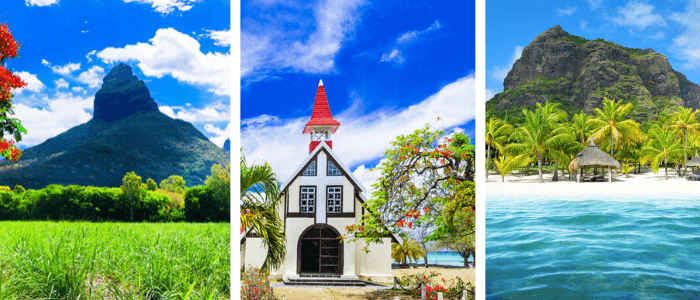 Mauritius Facts: Piton de la Petite Riviere Noire, Cap Malheureux, Le Morne
What you will find on Mauritius Facts for Kids:
Now let's start with a quick look at some fast facts about Mauritius:
Mauritius Facts - Snapshot
Last updated: 16 March 2026 - Sources: MTPA, StatisticsMauritius, MauritiusNow |
Here are some interesting Mauritius Facts which were chosen and researched by kids especially for kids.
Basic Facts About Mauritius
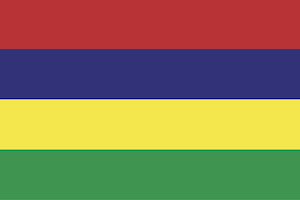 Mauritius flag
- Continent: Africa
- Name: Republic of Mauritius; also Republique de Maurice (French) or Republic Moris (Creole)
- Population: 1.24 million people (2025- StatisticsMauritius)
- Capital: Port Louis with about 150,000 inhabitants
- Motto: 'Star and Key of the Indian Ocean'

- Government: Democracy
- Languages: English (official), French, Creole
- Religion: mainly Hinduism (49%)
- Currency: 1 Mauritian rupee = 100 cents
- National Anthem: "Motherland"
- National Day: 12 March (Independence Day)
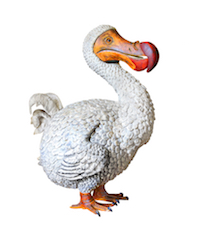 Dodo
Dodo- National Symbols: The extinct 'dodo' (national animal), Trochetia Boutoniana (Boucle d'orville - national flower), red, blue, yellow and green (national colours)
- History: The first settlers arrived on Mauritius in 1638, when the Dutch established a small colony on the island. The island was named by the Dutch after Prince Maurice of Nassau in 1598. The Dutch eventually abandoned the island in 1710 and then the French took control of the island in 1715, calling it Île de France. Later in 1810, the British captured the island during the Napoleonic Wars. Mauritius finally became independent from Britain in 1968.
- President: Dharam Gokhool (since December 2024)
Where is Mauritius?
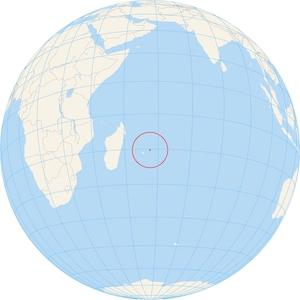
Mauritius is a small island country in the Indian Ocean. The volcanic island belongs to the African continent and is located in the Southern Hemisphere.
Mauritius is situated to the east of the African continent's mainland. The archipelago is located about 800 km/ 500 miles to the east of Madagascar.
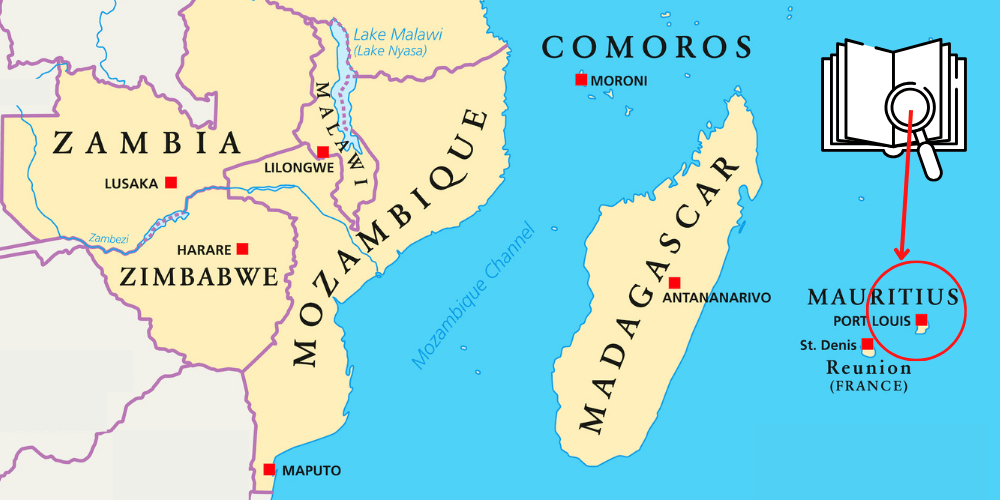 Here is Mauritius!
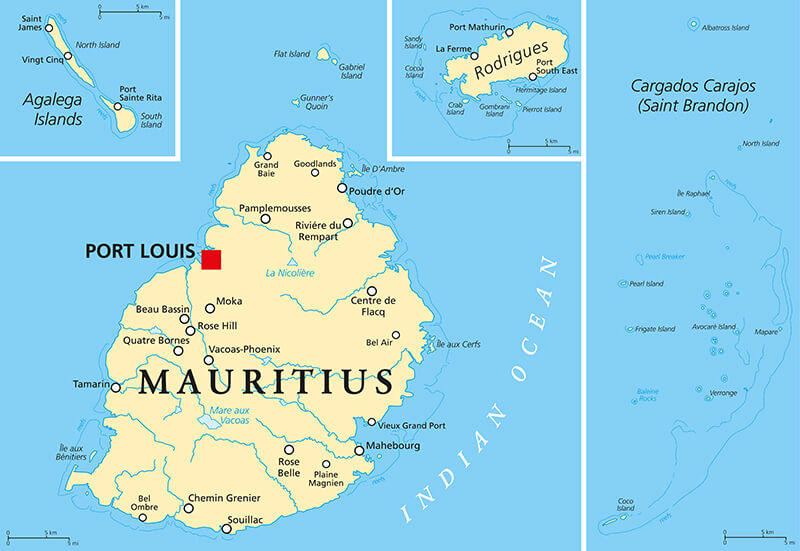
The island of Mauritius, called Île Maurice in French, is the largest island of the Republic of Mauritius and the second largest island belonging to the group of islands called the Mascarenes, or 'Mascareignes' in French.
Did you know?
|
The capital city of Mauritius is Port Louis, a city in the island's northwest. The population is concentrated around Port Louis and the central plateau. The main towns and urban areas are also found in the northwest and central regions of the island, especially around Ebène, which is Ebène is the country's main technology and financial centre. The southern and eastern parts of the island are less densely populated.
Mauritius Facts
Mauritius Geography
Mauritius is an Ocean State and has two main islands called Mauritius and Rodrigues.
Rodrigues is about about 560 km/ 350 miles to the east of Mauritius. The islands of Cargados Carajos Shoals, also referred to as Saint Brandon and the the Agalega Islands also belong to the Republic of Mauritius.
Did you know?
|
Mauritius was created by volcanic activity and emerged from the water more than 8 million years ago.
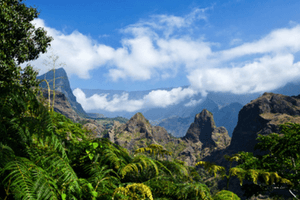
The landscape is varied. There is a central plateau rising to about 670 m/ 2,200 ft in elevation. Coral reefs and turquoise lagoons surround almost the entire island.
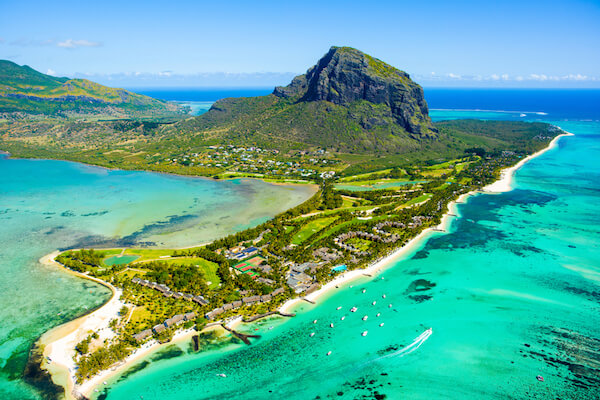
The island is also known for its underwater waterfall illusion! The underwater currents off the coast of Le Morne Brabant mountain create a unique impression of a huge underwater waterfall which in reality does not exist! This phenomenon is caused by sand and silt flowing off the continental shelf.
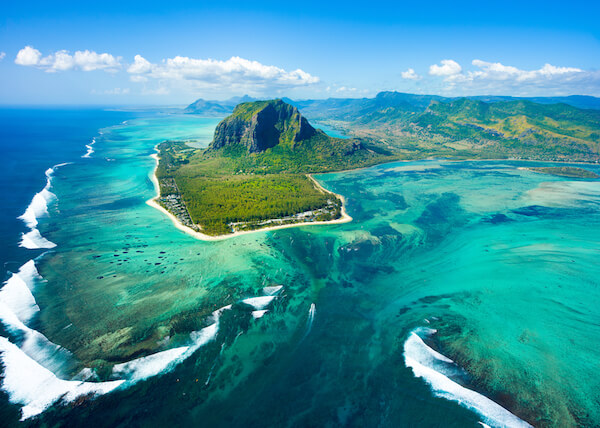 Le Morne with Morne Brabant and 'underwater waterfall'
Mauritius has a coastline of about 150 km/ 93 miles and the Indian Ocean island is known for its stunning white sandy beaches - just as this one at the foot of iconic Le Morne Brabant, a large basalt monolith, which is about 556 m/ 1,824 ft in height and a popular spot on the island for hikers.
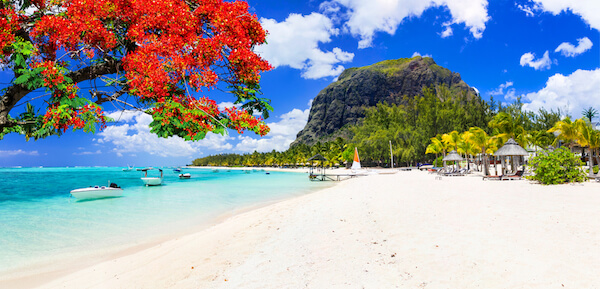 Le Morne beach
Mauritius is five times smaller than The Gambia, the smallest country in continental Africa. Comparing the land area of Mauritius with countries in Europe or North America, Mauritius is smaller in size than Luxembourg or smaller than Lincolnshire/ UK and a bit bigger than the state of Delaware in the USA or eleven times the size of Washington D.C.
To reach Mauritius, it takes a 4-hour flight from Johannesburg/ South Africa, a 12-hour flight from Paris/ France or a 13-hour flight from London/ UK. The national airline is called Air Mauritius.
Mauritius Climate
Mauritius has a tropical climate. It is warm all year round.
Summer in Mauritius is from November to April when it is hot and often rains in the afternoons, with the mean temperature 24.7°C/ 76°F.
Mauritian winters, from May to October, are cooler and drier. The mean winter temperature is 20.4°C/ 68°F. January to March is when the most rainfall occurs and it is cyclone season.
The ocean's temperature is very pleasant year-round, with water temperatures ranging from 23°C to 28°C/ 73°F to 82°F. Perfect weather to enjoy the beaches!
Source: Mauritius MetService, last accessed 16 March 2026
Mauritius Facts
Geo Superlatives
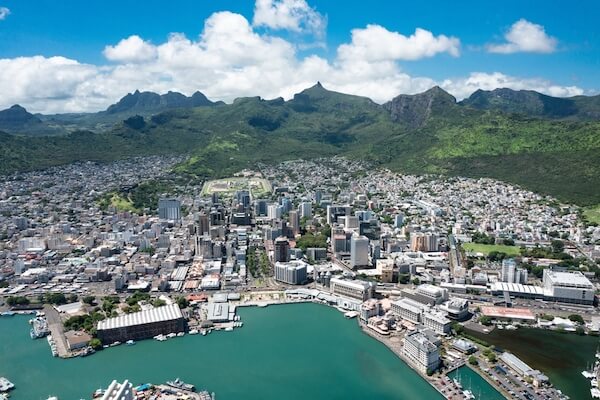 Port Louis
- The largest city of Mauritius is Port Louis, the capital city of Mauritius. It is also the most populous city of the island with roughly 150,000 inhabitants in the centre of the densely populated city. About half a million people live in the wider urban area of Port Louis.
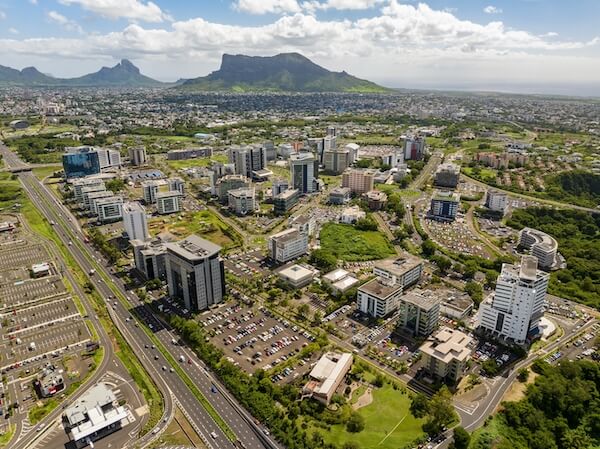 Ebene - main business hub - image by Lostsurf
- Mauritius is the most densely populated country on the African continent and one of the most densely populated in the world. This Indian Ocean country is also one of the most prosperous and rich countries on the continent. Mauritius is also known as the "techno island" with its "cybercity" Ebène, which is seen by many as the Information Technology (IT) and banking hub of Africa.
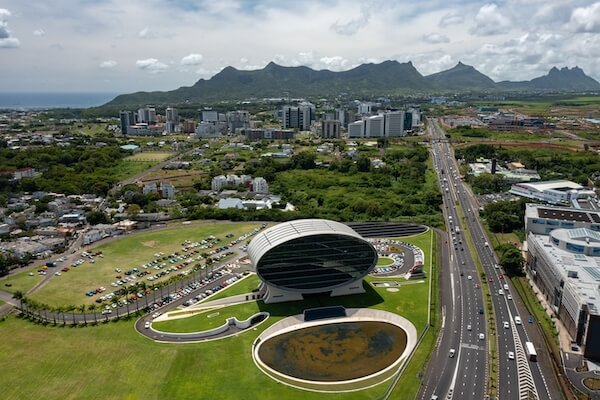 Mauritius Commercial Bank building in Ebène - image by Lostsurf/ shutterstock.com
- The island's highest mountain is the Piton de la Petite Riviere Noire, which means 'Peak of the Little Black River', with a height of 828 m/ 2,717 ft.
- The mountain is part of the Black River Gorges National Park. This national park is the largest in Mauritius. Here you can explore deep ravines and dense forests and spot many waterfalls. And beware the cheeky monkeys at the viewpoints!
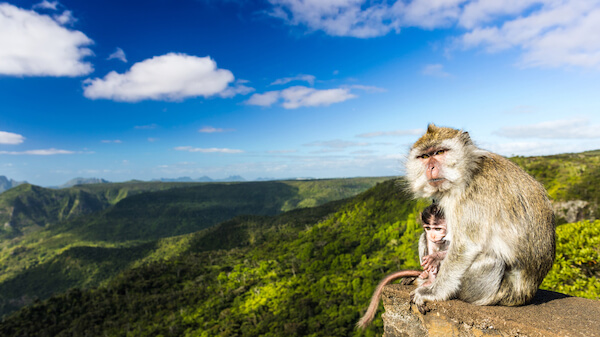 Black River Gorge viewpointDodo
- Mauritius is known as the birthplace of the Dodo, the famous extinct flightless bird that once lived only on Mauritius Island. The species was wiped out by the late 1600s after their habitat was lost mainly due to introduced animals and hunting activities of the Dutch settlers.
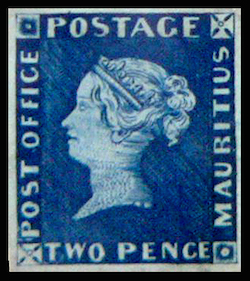 Blue Penny
- The first stamp ever issued is the 'Blue Mauritius' stamp which shows Queen Victoria on a blue background. The Blue Penny and the Red Penny stamps were among the first stamps distributed worldwide and were issued in Mauritius by the British government in 1847. Replicas of these stamps can be seen in the Blue Penny Museum at the Caudan Waterfront.
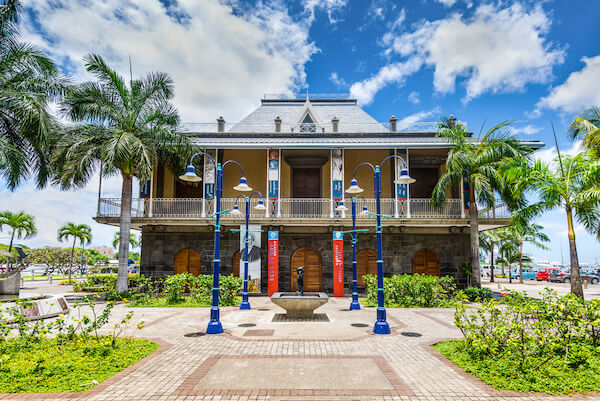 Blue Penny Museum - image by byvalet/ shutterstock.com
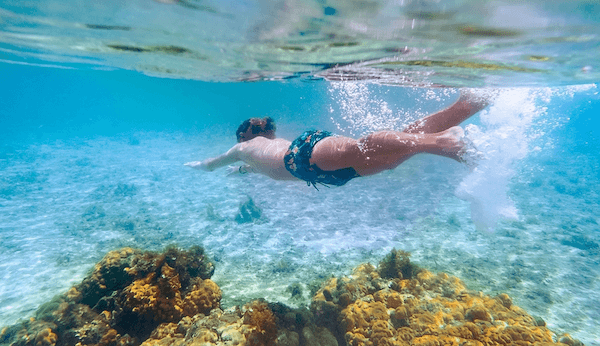
- Mauritius is also home to a large fringing coral reef that is one of the world's largest surrounding a single island.

Mauritius Facts
Landmarks & Attractions
Mauritius has many fascinating natural and historic landmarks. The Tamarin Falls are amongst the largest waterfalls of the country while the Seven Coloured Earths are a unique natural phenomenon.
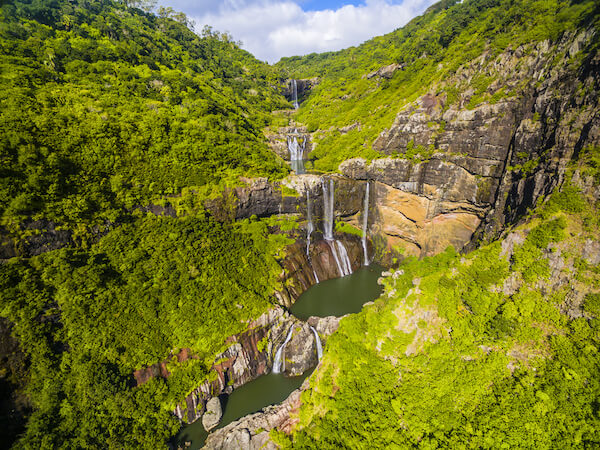 Tamarin Falls
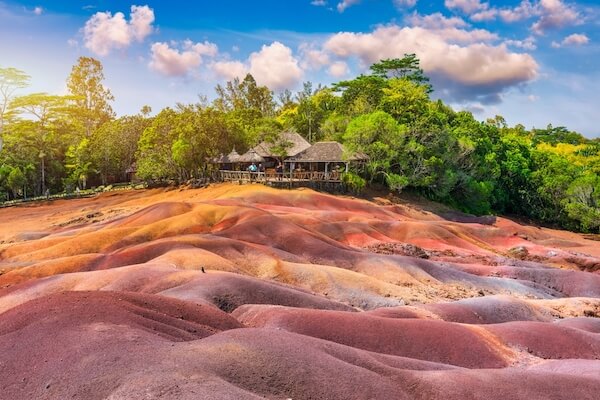 Seven Coloured Earths in Chamarel
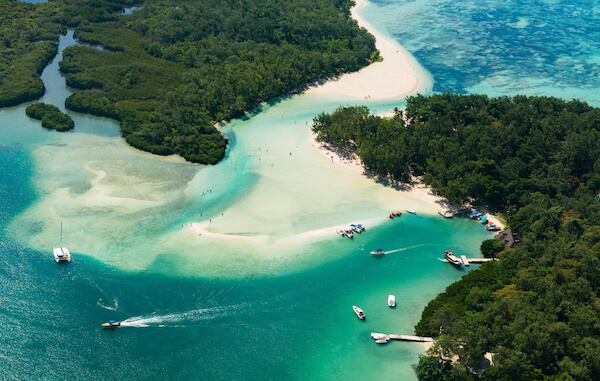 Ile aux Cerfs - a popular lagoon and private leisure island
Amongst the most famous man-made landmarks are the Citadelle in Port Louis and the ever-expanding Caudan Waterfront and the historic Central Market across the road.
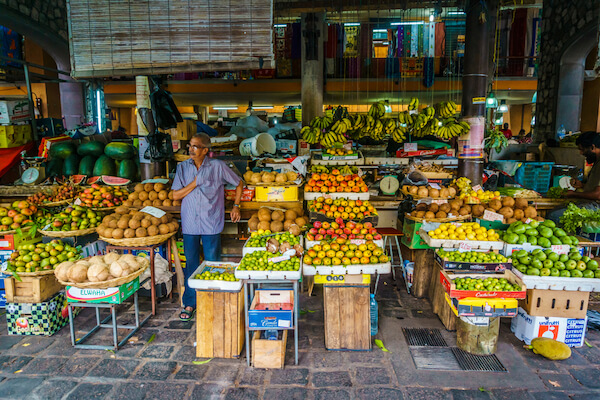 Central Market stall - image by Chandra Ramsurrun/ shutterstock.com
In Grand Bassin, the huge Lord Shiva Statue stands high on a hill overlooking the lake and is a popular pilgrimage site for the country's Hindu population. In the north, the pretty red-roofed church Notre-Dame Auxiliatrice at Cap Malheureux is a popular spot for weddings.
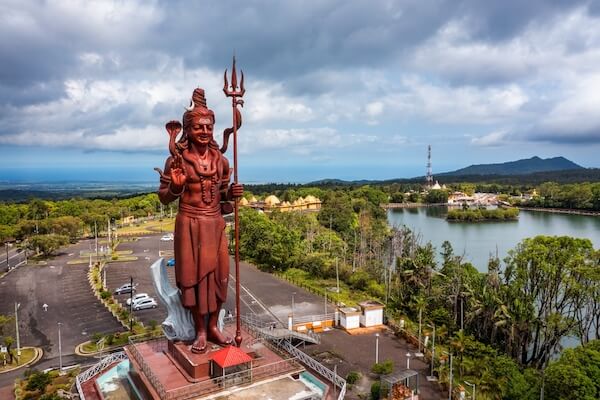 Statue of Lord Shiva in Grand Bassin
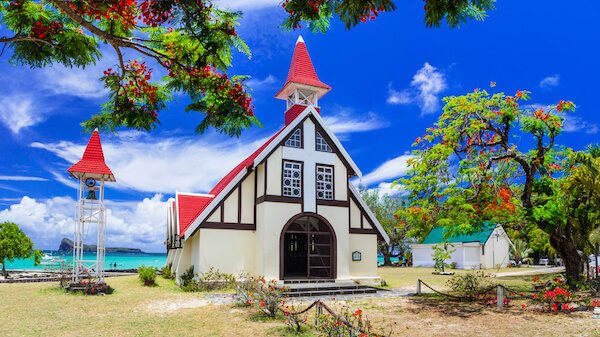 Church Notre-Dame Auxiliatrice at Cap Malheureux
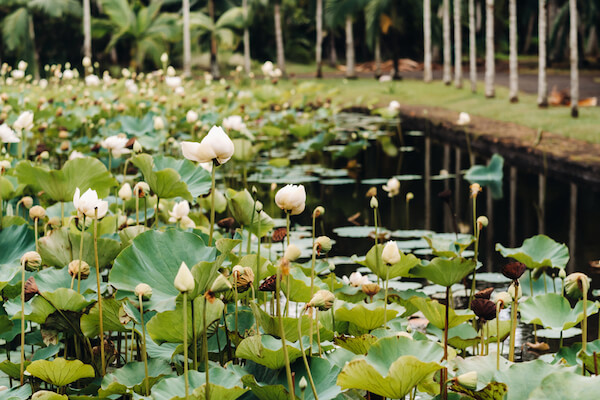 Sir Seewoosagur Ramgoolam Botanical Garden in Pamplemousses
Mauritius has two UNESCO World Heritage Sites: the natural landmark Le Morne Brabant and the historic monument to the abolition of slavery, Aapravasi Ghat in Port Louis.
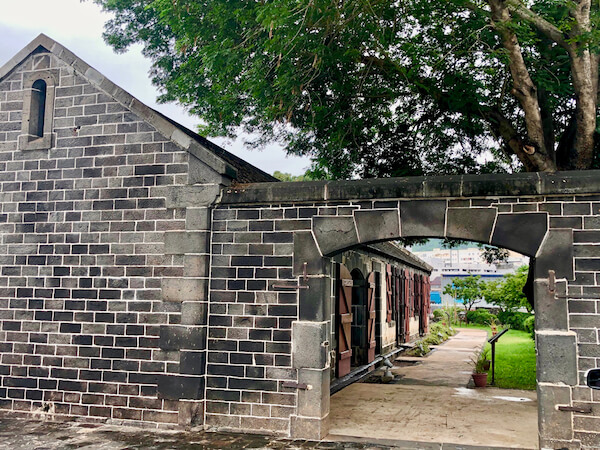 Aapravasi Ghat - image by Vera Duchovskaja/ shutterstock.comLe Morne Brabant
Did you know?
|
Mauritius Facts
People & Culture
Mauritius was uninhabited until the Dutch arrived in Mauritius in 1638. There is no indigenous human population on this island, nevertheless Mauritius is today one of the most multicultural places in the world. The Dutch and the French, then later the British used the country as a colony and grew the population with importing slaves mainly from Africa and Madagascar.
Due to its colonial history, many Mauritians have ancestors of Indian, French, British and Chinese origins, also due to the slave trade and indentured labour that was practised during colonisation. Mauritians are known to celebrate Diwali, Eid, Christmas, and Chinese New Year, often all in the same neighbourhood!
Here learn how Diwali is celebrated in Mauritius.
The majority of Mauritians are descendants from Indian people and are referred to as Indo-Mauritians.
Hinduism, Christianity, Islam, and Buddhism are all practised on the island, with almost half of the population practise Hinduism.
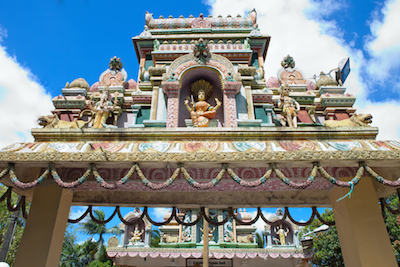 Mauritius Hindu Temple
Mauritians love celebrating their religious traditions and are also famous for their love of dancing the sega.
The Mauritian folk dance is the sega. This dance shows influences from the Indian dance style, where the whole body moves with the music - interestingly however, the feet of the dancer don't leave the ground.
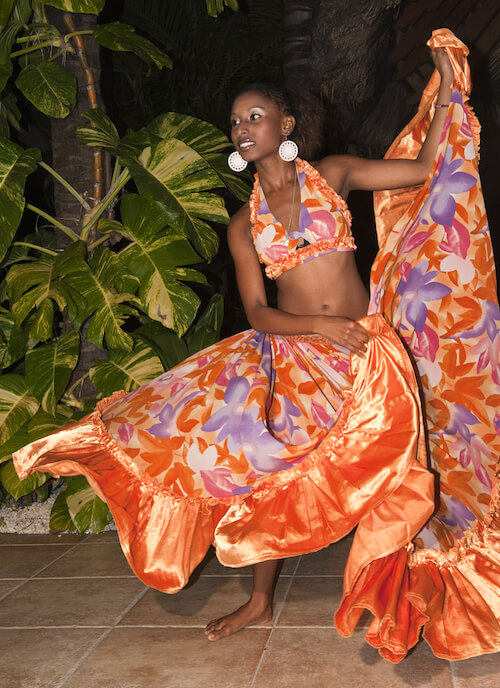 Mauritian segadancer
The sega dance is also popular on the Seychelles islands and La Réunion.
The most famous Mauritian story is probably that of Paul et Virginie, or as they say in English 'Paul and Virginia'. These two characters stem from a French novel by Jacques-Henri Bernardin de Saint-Pierre dating back to the late 18th century. This is a tragic love story which is very famous on the island.
Mauritius Facts
Creole Language
French, English and Creole are the main languages in Mauritius. English is the official language and considered by many to be the main business language, however newspapers and TV and radio news are mainly broadcast in French or Creole.
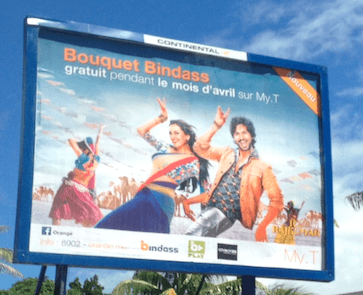 Roadside Advertisement in Mauritius
Most people speak Mauritian Creole at home. Furthermore various Asian languages such as Tamil, Urdu, Hindi or Mandarin are spoken by the local Indian and Chinese population.
Mauritius Facts
Animals on Mauritius
Mauritius is known for some of the rarest plants and wildlife.
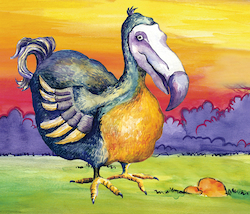 Dodo - The extinct flightless bird
Less than 2% of the land is still covered by native forest and thus much of the habitat of the native animals has been destroyed. Due to human activities and introduced animals, the Mauritian national animal called the "dodo" has become extinct around 1681.
The Mauritian flying fox are the last remaining endemic mammals on the island. One of the rarest birds, the Mauritius kestrel, luckily recovered from only 4 to about 400 birds through strong conservation efforts.
Today, there are pink pigeons and geckos which you can encounter on a visit to the island. Pods of dolphins can sometimes still be seen in Tamarin Bay. The Aldabra giant tortoises that were introduced from the Seychelles, live over 100 years and you can see some of them in the botanical garden and nature reserves.
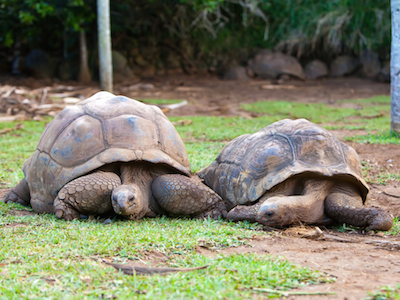 Giant Tortoises
There is also a crocodile park on Mauritius, however, in nature there are no crocodiles or poisonous animals, including snakes or dangerous scorpions, found on Mauritius.
Mauritius Facts
Mauritius Economy
The Mauritian economy is based mainly on tourism, sugar, fish processing, textile manufacturing as well as financial and IT services. Mauritius welcomed almost 1.5 million tourists in 2025.
The country has impressive agricultural and food industry and houses some of the most advanced tuna processing facilities in the world.
Did you know?
|
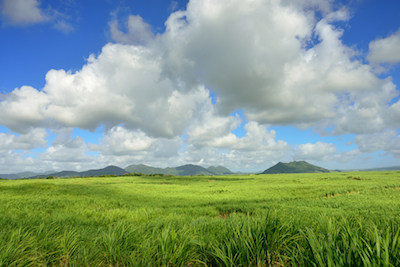 Sugarcane field
Agriculture is a major business sector on the island and sugarcane still covers about 90% of cultivated land. Sugarcane, tea, potatoes and bananas are the main agricultural products in Mauritius. Pineapple plantations and papaya farms can also be seen across the island.
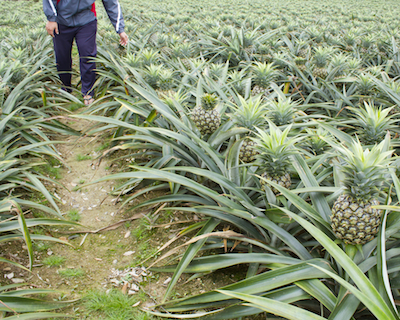 Did you know pineapples grow in low plants?
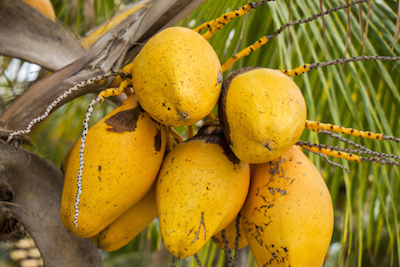 Papaya fruits grow on trees
The main trading partners of Mauritius are France, the USA, the UK and South Africa for exports and China, India, France and South Africa for imports.
Mauritius Facts
Food in Mauritius
Mauritian cuisine is a fusion of Indian, African, Chinese, and French cooking. Traditional dishes include plenty of fresh vegetables, tropical fruits and fish or seafood. The Mauritian cuisine is also well known for its exotic spices.
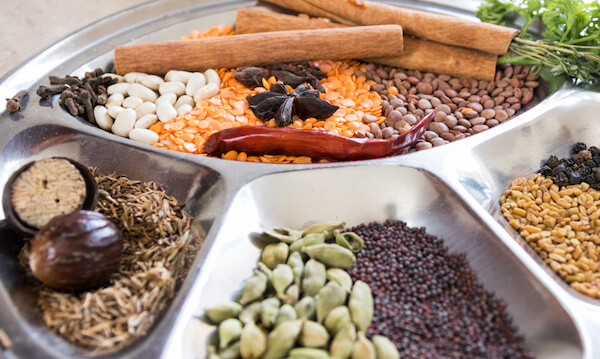 Mauritian spices: Cinnamon, cloves, cumin, coriander, star anise, cardamom with beans, nuts and lentils - which ones do you recognise?
The Mauritian cuisine has many influences. Asian, Indian, European specialties all can be found in the local cuisine. Here is some typical Mauritius food:
- Achard: pickled vegetable with spicy relish made with mustard seeds
- Dholl puri: these flatbreads are made with split-pea flour and served with a typical Mauritian curry and are a common street food, sometimes even called the national dish.
- Mauritian curries: stews mainly made with chicken, fish or squid marinated and served in a spicy red curry sauce
- Gateaux Piments: chilli bites made with split peas and lots of chilli are a very popular spicy snack.
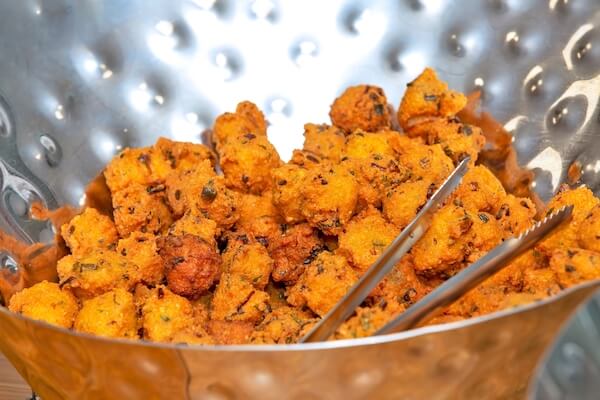 Chilli bites
- Vindaye: usually made with fish that has been coated in turmeric, ginger, chilli and mustard seeds
- Rougaille: Fish or meat stew with a spicy tomato sauce with chilli, garlic, onion and thyme
- Salade palmiste: this salad is also called 'Heart of Palm' salad and is an expensive delicacy, using only the inner parts of a palm tree
- Boulet or Dim Sum: steamed dumplings filled with a variety of fillings, originating from the Chinese cuisine
- Coconut water: you simply must try the fresh coconut drink. Did you know that the liquid of coconuts is transparent just like water but has a distinct sweet taste. Coconut meat is used in many dishes too!
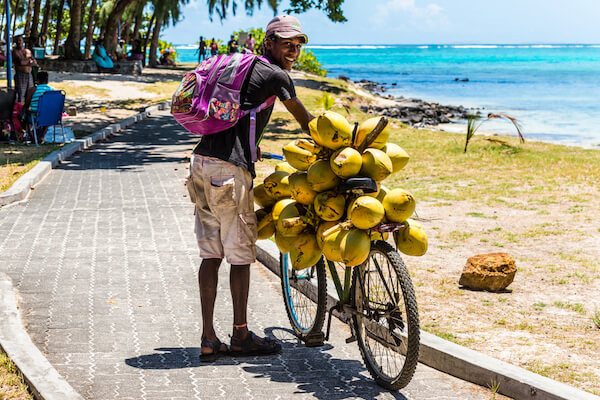 Fresh coconuts are transported by bike
For tasting the many different variations of sugar, go to 'L'Aventure du Sucre', a still-working sugar factory with a wonderful museum with lots of interactive displays and don't miss a visit to a tea plantation on the island. Bois Chéri plantation has an amazing Vanilla Tea!
Read more about great Mauritian specialties here
Mauritius Facts
FAQs
Where is Mauritius?
Mauritius is a small island country in the Indian Ocean, to the east of the African mainland and east of Madagascar.
What is the capital city of Mauritius?
The capital city is Port Louis. It is the country’s main harbour and an important centre for business and trade.
What languages do people speak in Mauritius?
The official language used in government is English, but many people speak French and Mauritian Creole in everyday life.
What is Mauritius famous for?
Mauritius is famous for its beautiful beaches, coral reefs, and lagoons. It is also known for the extinct dodo, the national animal, its sugar cane plantations, tropical forests and holiday resorts.
What animal is uniquely Mauritian?
One famous animal from Mauritius is the Dodo. This flightless bird lived only on the island but became extinct in the late 1600s after the island was colonised.
What do people eat in Mauritius?
Mauritian food is influenced by Indian, African, Chinese, and French cuisines. Popular dishes include Dholl puri, a flatbread filled with ground split peas, chilli bites and spicy curries.
What colours are on the Mauritius flag?
The flag of Mauritius has four horizontal stripes: red, blue, yellow, and green. These colours are said to represent the struggle for freedom, the Indian Ocean, sunshine, and the island’s green nature.
Which religions do people follow in Mauritius?
Mauritius is a multicultural country where people follow many religions. The largest religion is Hinduism, but many people also follow Christianity, Islam and Buddhism.
Which traditional music comes from Mauritius?
One popular style of music is Sega. It developed from African rhythms and is usually played with drums and triangle instruments.
Which traditional dance is performed in Mauritius?
The traditional dance of Mauritius is the Sega dance. Dancers wear a colourful dress and dance to lively rhythms.
Mauritius Facts
Resources
Resources for Mauritius Facts page:
- Statistics Mauritius. "Population and Vital Statistics." StatisticsMauritius. Last accessed 16 March 2026
- Mauritius Meteorological Service. "Climate of Mauritius." Mauritius MetService. Last accessed 16 March 2026
- Les Iles Vanillas. "Ile Maurice - Mauritius". Vanilla Islands. Last accessed 16 March 2026
- Tourism Mauritius. "Culinary Experience." Tourism Mauritius. Last accessed 16 March 2026
- Mauritius Tourism Authority. "Wildlife in Mauritius." MauritiusNow. Last accessed 16 March 2026
- Government of Mauritius. "Overview of Mauritius." Ministry of Tourism. Last accessed 16 March 2026
Picture Credits on Mauritius Facts: All Pictures, own photos and if not otherwise mentioned from sxc.hu and shutterstock.com
Popular Pages
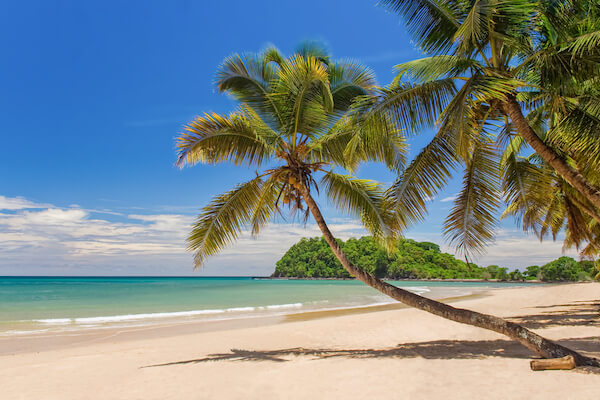
 |
 |
 |
 |
We hope you enjoyed reading our Mauritius Facts. Please bookmark this page and spread the word. We will add more Mauritius Facts in the near future.
Competition
2026
Recent Articles


-
Facts about Tuvalu for Kids: Geography, People and Wildlife
Sep 11, 26 07:15 AM
Explore our facts about Tuvalu and learn about the Polynesian island nation and its geography, people, economy, culture and animals - Worksheets included -
Animals in Norway for Kids: Wildlife Facts
Sep 03, 26 10:50 AM
Animals in Norway explained: meet reindeer, moose, polar bears, whales and puffins, with habitat facts and a short quiz for class. -
Norway Facts for Kids: Fjords, Vikings and Reindeer
Sep 01, 26 09:01 AM
Learn Norway Facts about the land of the Nobel Prize, the Vikings, reindeers, trolls and other attractions
More about Mauritius
More about Africa
More Countries in Africa
 Tanzania
***
Fun Facts
***
***
Fun Games
Spread the Word

Like us on Facebook


Competition 2026