- Homepage
- Essay 2026 Senior Runner-Up
Where Two Worlds Meet
Essay Writing Competition 2026
Category: 12 - 15 years
- Runner-Up -
 |
Runner-Up: "Where Two Worlds Meet" by Yukari Saijo from Japan |
This essay was submitted in the Kids World Travel Guide Essay Competition 2026 in the Senior Category 12 - 15 years.
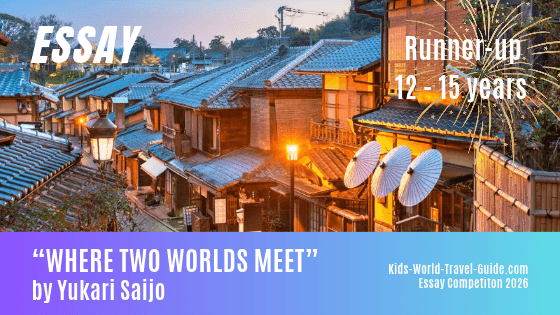
Where Two Worlds Meet
Some landmarks tower over cities. Others have their names on mountains. Mine is small enough to walk past without noticing. Yet stepping inside felt like entering a whole different world.
A symphony of soft clinks invited me inside as I made my way through a narrow corridor, barely wide enough for one person. Moving down the dark hallway, I searched for a glimpse of light as the smell of old wood filled the dry air and the walls brushed close on each side. Soft warm light finally leaked through a thin cloth covering the room ahead.
Intrigued by what was waiting for me on the other side, I pushed the fabric away and stepped inside to a sea of vividly colored snacks. Handwritten paper signs in vibrant colors hung over the shelves, filled with Japanese characters. This was dagashiya, a traditional Japanese shop that sells cheap snacks, candies, and little treats.
At eleven years old, having just returned from Singapore, I was in awe of the countless colorful candies. Living overseas my whole life, I felt like I had unlocked a corner of childhood I had only ever seen in anime or manga. To my left was a purple packaged fruit roll candy, supposedly as long as your whole arm. On my right sat rows of packages of fūeramune, a popular Japanese candy. There were six per case, each with a hole in the middle, like a donut. I later learned that these sweets were called "fūeramune" or "flute ramune". Kids put the fūeramune between their teeth and blow into it, creating a flute-like sound. For me, this wasn’t simply an old shop filled with candy; it was a glimpse of a Japanese childhood I never got to experience.
Living overseas for almost all my life meant I was fluent in English and familiar with Singaporean culture. However, at home, I would communicate with my parents in Japanese, leading to my enrollment in a Japanese school during the last two years of my stay overseas. Because of my background, I often felt caught between the two worlds, ethnically Japanese, yet culturally a stranger, with my actions and thoughts shaped by Singapore. Yet inside this tiny shop, the feeling of being an outsider disappeared. All the fascinating sweets around me didn’t make me feel like I had to fit in or prove my cultural identity. For once, it didn’t feel like there was a big wall between me and Japan; it felt like an invitation to get to know Japan better.
That spark of curiosity didn’t end after I left the shop. I started paying attention to the small details in Japan: how people held chopsticks, the angles of a bow, and even the quiet but meaningful local interactions between people. Things that I often overlooked became things I wanted to understand. I began to realize that I did not have to choose between the two countries, but could be a bit of both. I was a mixture of both Japan and Singapore, and I could continue searching for the missing parts of each culture that I had yet to understand.
Just as I began noticing the small details around me in Japan, I eventually discovered my passion for the environment. I started connecting what I had learned from Singapore with what I was learning in Japan, giving me a broader perspective on environmental issues. I hope to turn my combined knowledge and experience into action and contribute to a world where people pay more attention to things they often overlook. The dagashiya wasn’t a monument or a World Heritage Site. It was a tiny shop that was hidden behind the curtains and it became the turning point in the way I thought.
I no longer saw the distance between Singapore and Japan as a wall I could never break through, but as a bridge connecting the two cultures and shaping my identity.
Some landmarks tower over cities. Others have their names on mountains. Mine is barely big enough to catch your eye, but stepping inside proved that the ones that leave the biggest marks on us are the ones that look the smallest.
Congratulations, Yukari! Your amazing essay has been selected as a runner-up in the 12-15 years age category!
Your reflective writing stands out through its rich personal insights and is one of the most authentic essays we have received in this year’s competition. You described the setting of the traditional dagashiya so vividly, introduced your sophisticated vocabulary so skillfully and have woven the exploration of your cultural identity so nicely into the story.
A truly moving and inspiring piece of creative storytelling!
Yukari is 14 years old and attends Ichikawa Gakuen Junior High School in Japan. English as second language. Home language is Japanese. Here is the short author's note Yukari provided with his entry:
"I chose a dagashiya because it’s a small, ordinary place that had a surprisingly huge impact on me. Growing up overseas, I never had the chance to experience this part of Japan, and visiting this magical place revealed a different side of Japan."

Thank you for sharing this truly magical traditional place with us. This is indeed a landmark unlike any other! And well done for exploring your cultural identity so beautifully! Congratulations again!
Competition Winners 2026
 |
 |
 |
|
 |
 |
Competition Winners 2025

Competition Winners 2024
 |
 |
 |
 |
 |
 |
 |
 |
Competition Winners 2023
 |
 |
Competition Winners 2022
 |
 |
 |
 |
 |
 |
Popular Pages
 |
 |
 |
 |
Competition 2021 Essays
 |
 |
 |
 |
 |
 |
Recent Articles


-
Where Two Worlds Meet: Senior Runner-up 2026 - Japan
Nov 02, 26 10:59 AM
Where Two Worlds Meet was chosen one of the senior runners-up in our writing competition 2026 -
Wonders of My World: The Parthenon Reminisces - Essay Winner 2026
Nov 02, 26 10:52 AM
In our Wonders of My World Essay Competition 2026, Ira's essay about the Parthenon was chosen winner in the junior category -
My Favourite Landmark - Winning Essay 2026 Senior - France
Nov 02, 26 10:49 AM
My Favourite Landmark was chosen as the winning essay in the senior category of Kids World Travel Guide's writing competition 2026 -
Essay Winners 2026: The Best Stories From Our Writing Competition
Nov 02, 26 10:16 AM
Congratulations to all our Essay Competition Winners of 2026! And a heartfelt Thank You to all who participated in our annual essay competition. -
Wandering History: The Alhambra - Senior Runner-up 2026
Nov 02, 26 09:32 AM
Wandering History was chosen a runner-up in the senior category of our writing competition 2026 -
My Favourite Place: Jamsil Baseball Stadium - Junior Runner-up 2026
Nov 02, 26 09:03 AM
My Favourite Place: Jamsil Baseball Stadium was chosen as runner-up in the 2026 writing competition - Junior Category -
Landlocked Countries | Geography for Kids | Enclaves | Travel
Oct 31, 26 06:52 AM
There are 44 landlocked countries in the world. Let's learn about which countries are called landlocked, where they are and geo superlatives for these places -
Cities around the World | Megacities | Geography | Megacity Facts
Oct 30, 26 08:32 AM
Cities around the world: World Cities Day is celebrated on 31 October, read here fascinating megacity facts and info about cities around the world
Go back from "Where Two Worlds Meet" to Kids-World-Travel-Guide Homepage
Competition
2026
Winning Essays 2026
More about
Christmas